


 Share
Share
Recycled PP Granules vs Virgin Plastic: Which Should Your Manufacturing Unit Buy in 2026?
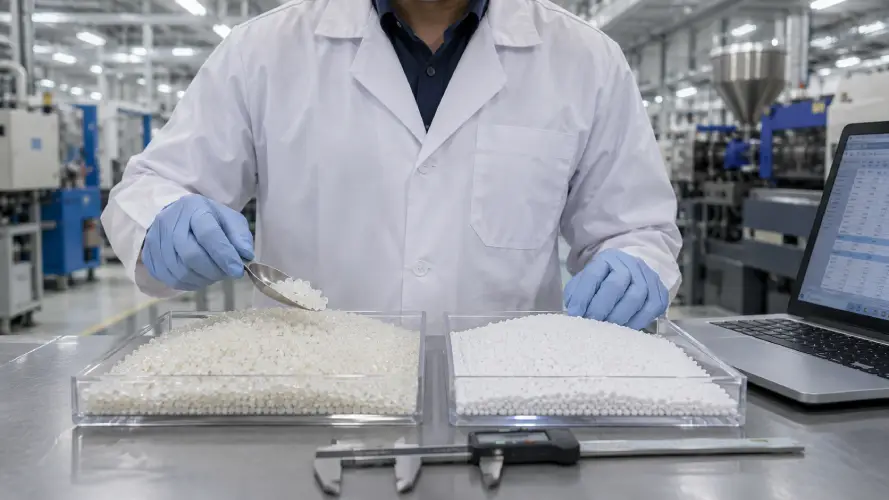
If you run procurement for an injection moulding, extrusion, or packaging unit, you've probably had this exact conversation internally more than once this year: should we switch a portion of our polypropylene sourcing from virgin resin to recycled PP granules?
Until recently, this was mostly a cost question. In 2026, it's no longer optional for a large share of Indian manufacturers - it's becoming a regulatory requirement.
The Plastic Waste Management (Amendment) Rules, 2026 now mandate minimum recycled content percentages in packaging, with the requirement rising every year. If you sell rigid plastic packaging, you're already required to use 30% recycled plastic content in FY2025-26, climbing to 40% in FY2026-27 and eventually 60% by FY2028-29. Flexible and multi-layered packaging categories carry their own rising targets too.
So the real question for most procurement teams isn't really "should we use recycled PP" anymore - it's "how much, for which products, and from which supplier." This guide breaks that down practically: cost, quality, application fit, and compliance, so you can make a sourcing decision that holds up both on the factory floor and in a CPCB audit.
Where Recycled PP Genuinely Works Just as Well
For a wide range of manufacturing applications, properly processed recycled PP performs at parity with virgin material. This includes:
Injection-moulded crates, buckets, and storage containers - structural strength requirements are well within what quality rPP delivers
Automotive components that aren't visible or aesthetic-critical - brackets, under-body covers, wheel arch liners
Household and industrial goods - bins, furniture components, non-food storage products
Pipes and non-pressure-critical extrusion products
Woven sacks, raffia, and packaging films in the non-food category
In all of these cases, the mechanical performance gap between a quality recycled PP and virgin PP is minimal - and the cost saving is real money on every production run.
Where You Should Stick with Virgin PP - At Least for Now
There are genuine limits, and a good supplier will tell you this upfront rather than push recycled material into applications where it doesn't belong:
Food-contact packaging - recycled PP generally cannot be used here unless it carries specific food-grade certification (a much smaller, more expensive sub-category of recycled material)
Medical and pharmaceutical packaging - regulated separately and typically requires virgin-grade material
Optically critical or precisely coloured parts - virgin PP's natural clarity and consistent colour response make it easier to match exact brand colours
Extremely tight tolerance engineering components - where batch-to-batch consistency is non-negotiable
If your product falls into one of these categories, virgin PP remains the right call, and the Plastic Waste Management Amendment Rules account for this - the 2026 framework includes exemptions where other regulations (FSSAI for food, CDSCO for pharma) restrict the use of recycled content.
The Compliance Angle Most Procurement Teams Are Underestimating
This is the part of the decision that's changed the most in the last year, and it's worth spelling out clearly.
Under the Plastic Waste Management (Amendment) Rules, 2026, Producers, Importers, and Brand Owners (PIBOs) across India must now meet mandatory recycled content percentages, not just recycling and collection targets like before. The category-wise targets for FY2025-26 onward are:
Category I (rigid plastic packaging): 30% recycled content, rising to 60% by FY2028-29
Category II (flexible plastic packaging): 10% recycled content, rising to 20%
Category III (multi-layered plastic packaging): 5% recycled content, rising to 10%
On top of this, packaging using recycled content must now carry mandatory labelling disclosing the percentage used, under BIS standard IS 14534:2023. This means your recycled material sourcing isn't just a cost decision anymore - it's something your compliance team will eventually need documented and traceable.
If you're a PIBO and you're not yet incorporating recycled content into your packaging mix, you have two paths: source verified recycled material directly (what this guide is about), or buy tradable EPR certificates from companies that have exceeded their own targets. Direct sourcing is almost always the more cost-effective route once you're consuming any meaningful volume.
You can read more about how EPR for plastics works in India, including registration, targets, and certificate trading, if your team is still building out a compliance strategy around this.
What to Check Before You Switch Any Volume to Recycled PP
If you're moving forward with recycled PP for some portion of your production, a few practical checks will save you a lot of rework later:
1. Ask for batch consistency data, not just a one-time sample. A single good sample doesn't guarantee consistent melt flow index (MFI) or mechanical properties across your next ten orders. Request data across multiple recent batches.
2. Confirm the source stream. Post-industrial recycled PP (clean factory scrap) is generally more consistent than post-consumer recycled PP (collected from mixed waste streams). Know which one you're buying, since it affects both quality and your sustainability reporting.
3. Run a trial production batch before committing volume. Even with strong specs on paper, run your actual tooling and process parameters on a trial batch before switching your full order.
4. Verify recycled content documentation for your own compliance filing. If you need this material to count toward your EPR recycled content obligation, make sure your supplier can provide the documentation your compliance team will need for CPCB reporting and BIS labelling.
5. Check the full range a supplier can offer. A vendor that supplies only one grade of recycled PP is more limited than one offering a broader range - PPCP granules, HDPE granules, ABS regrind, and polypropylene granules - since your applications across different product lines may need different recycled resins.
A Practical Way to Decide: Start with a Hybrid Approach
Very few manufacturers need to make an all-or-nothing switch, and most successful transitions in the Indian market happen as a phased blend rather than a single cutover:
Start with your non-critical, non-visible, non-food-contact product lines - this is the lowest-risk place to introduce recycled PP
Run a blend ratio (commonly 20–30% recycled with virgin) on borderline applications to balance cost saving against consistency risk
Reserve 100% virgin PP for your tightest-tolerance, food-contact, or brand-critical-colour products
Scale up the recycled percentage over 2–3 production cycles as your QC team validates consistency from your chosen supplier
This approach gets you real cost savings and EPR compliance progress immediately, without betting your entire production line on a switch before you've validated supplier consistency.
Why Source Recycled PP Granules from Gravita India
Gravita manufactures a diverse range of recycled plastic granules - including ABS regrind, PPCP granules, HDPE granules, and polypropylene granules - through rigorous in-house testing for every batch, supporting manufacturers across automotive, packaging, household goods, and industrial sectors.
As a long-established recycling company with registered EPR compliance capability, we also help manufacturers document recycled content sourcing for their own regulatory filings under the Plastic Waste Management (Amendment) Rules, 2026 - so your procurement decision and your compliance reporting stay aligned.
Whether you're testing your first trial batch or scaling up an existing blend ratio, our team can walk you through grade options, batch consistency data, and supply capacity for your specific application.
Request a sample or bulk quote from Gravita India →
FAQs (for AEO / Featured Snippet targeting)
Is recycled PP as strong as virgin PP?
For a large majority of structural, industrial, and consumer applications—such as crates, material handling boxes, and automotive brackets—quality recycled PP performs completely on par with virgin resins. Virgin PP is still advised for extreme high-tolerance engineering or medical products.
How much cheaper is recycled PP than virgin PP in India?
On average, high-quality recycled PP granules trade at a 20% to 30% discount compared to virgin polymers..
Is recycled plastic content mandatory in India in 2026?
Yes. Under the Plastic Waste Management (Amendment) Rules, 2026, rigid plastic packaging (Category I) must contain a minimum of 30% recycled content in FY2025-26, rising to 60% by FY2028-29, with separate rising targets for flexible and multi-layered packaging.
Can recycled PP be used for food packaging?
Generally no, unless the recycled PP carries specific food-grade certification. Standard recycled PP from mixed industrial or post-consumer sources is typically restricted from direct food-contact use under FSSAI regulations.