


 Share
Share
Recycled Lead vs Primary Lead: Quality, Performance & Economics
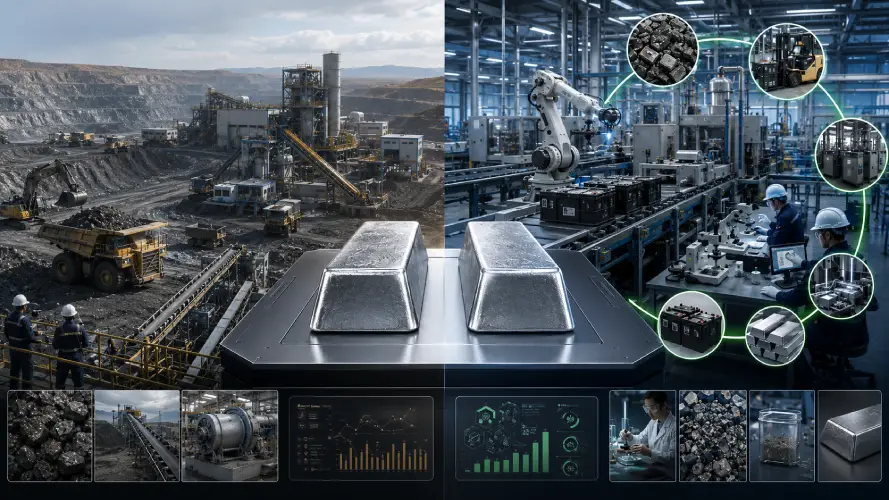
When manufacturers need lead for their products, they face a choice: primary lead extracted directly from ore, or recycled lead recovered from waste streams. The decision is critical-lead quality impacts product performance, cost, and sustainability. Many manufacturers assume virgin lead is superior, but the reality is more nuanced. Recycled lead from certified processors can meet the same industry standards while offering significant economic and environmental advantages. Understanding the differences between recycled and primary lead is essential for procurement professionals, manufacturers, and anyone involved in supply chain decisions.
What is Primary Lead?
Primary lead, also called virgin lead or mined lead, is lead extracted directly from ore deposits through traditional mining operations. Lead ore (galena) is mined, concentrated, and smelted to produce pure lead. The process involves mining the ore, crushing and concentrating it, smelting to remove impurities, and refining to achieve desired purity levels. Primary lead production is capital-intensive, requiring large mining operations, smelting facilities, and significant energy input. Primary lead production generates significant quantities of mining waste, depending on ore grade, mining practices, and processing methods.
Primary lead production is energy-intensive and environmentally disruptive. Mining operations alter landscapes, consume water resources, generate waste streams, and carry geopolitical risks. Dependence on primary lead can expose manufacturers to supply chain risks arising from mining activity, geopolitical factors, and commodity market fluctuations. Additionally, primary lead production typically requires electrical inputs, fossil fuel consumption, and extensive processing of low-concentration ore.
What is Recycled Lead?
Recycled lead, also called secondary lead, is lead recovered from end-of-life products and waste streams through professional processing. Common sources include spent batteries (the primary source), construction materials, automotive components, and industrial waste. Lead has exceptional recycling properties-it can be recycled indefinitely without loss of quality. Recycled lead is collected, sorted, processed, and refined to meet the same purity and performance standards as primary lead.
The recycling process is more efficient than virgin production. Lead-acid batteries are systematically collected, dismantled, and processed. Lead is separated from other materials, refined, and cast into ingots. Modern recycling facilities are capable of achieving very high recovery efficiencies from spent lead-acid batteries, depending on technology and operating practices. Recycled lead production uses substantially less energy than primary lead smelting and generates significantly less waste. The process requires professional equipment and skilled operators but represents mature, proven technology.
Quality Comparison: Recycled vs Primary Lead
A critical misconception is that recycled lead has inferior quality to primary lead. This is a common misconception. When processed by licensed, regulated facilities, recycled lead meets or exceeds industry standards for composition, purity, and performance. Both are manufactured to meet applicable industry specifications and customer requirements.
Purity Levels: Both recycled and primary lead achieve 99.9%+ purity when processed to standard specifications. Quality control testing for both materials includes composition analysis, mechanical property testing, and contamination detection.
Mechanical Properties: Properly processed recycled lead can meet the mechanical property requirements specified for its intended application. Manufacturing specifications cannot distinguish between properly processed recycled and primary lead.
Trace Element Composition: Both are refined to meet trace element specifications. If recycled lead contains slight trace element variations, it is further refined through additional processing steps until it meets specifications.
Performance in Applications: In battery manufacturing, construction, radiation shielding, and other applications, properly processed recycled lead delivers comparable performance when refined to the required specifications. Extensive testing and real-world use confirm equivalent performance.
Certification and Documentation: Recycled lead from certified processors comes with composition certificates, testing data, and full traceability documentation. This documentation provides confidence that materials meet specifications.
Cost Comparison
Recycled lead can often offer cost advantages over primary lead, depending on market conditions, material specifications, and regional supply dynamics. This cost advantage reflects lower processing costs (less energy-intensive than primary smelting) and lower raw material costs (collected waste rather than mined ore). During periods when primary lead prices are high, recycled lead becomes even more economically attractive.
For manufacturers, the economic advantage is significant. An automotive manufacturer consuming thousands of tons of lead annually saves millions by sourcing recycled lead. Battery manufacturers that shift to battery recycling and material recovery systems can create more circular supply chains by using recovered lead as an input for new battery production.
Beyond direct material costs, recycled lead offers supply chain value. Stable, locally-sourced supply reduces vulnerability to geopolitical disruptions, mining strikes, or market price volatility. Companies can contract with certified battery recycling and material recovery companies for guaranteed long-term recycled lead supply, providing budget predictability impossible with volatile primary lead markets.
Environmental and Sustainability Advantages
Environmental Benefits of Recycled Lead:
· Energy Efficiency: Recycled lead production generally consumes significantly less energy than primary lead production.
· Waste Reduction: Mining and processing primary lead generates massive waste streams. Recycled lead production generates minimal waste.
· Water Conservation: Primary lead mining consumes significant water and risks water contamination. Recycled lead processing requires far less water.
· Habitat Protection: Reducing mining demand protects ecosystems from mining operations, habitat destruction, and mining waste impacts.
· Carbon Footprint: Lower energy consumption and eliminated mining transport directly reduce manufacturing carbon footprint.
· Closed Loop Contribution: Recycled lead enables closed loop manufacturing systems where materials flow continuously rather than becoming waste.
Regulatory and Compliance Advantages
Extended Producer Responsibility (EPR) schemes increasingly require manufacturers to manage end-of-life products. Lead-acid battery producers face EPR mandates to ensure proper battery collection and recycling. By sourcing recycled lead from certified processors, manufacturers fulfill EPR obligations while securing material supply. This can strengthen compliance readiness while supporting long-term material security.
Corporate sustainability commitments drive demand for recycled materials. Major manufacturers publish sustainability goals targeting increased use of recycled inputs. Sourcing recycled lead helps companies meet public commitments, demonstrate environmental leadership, and satisfy increasingly environmentally conscious investors and customers.
Lead Recovery Process and Quality Assurance
Professional lead recycling follows rigorous processes ensuring quality. Collection systems systematically gather lead-acid batteries and lead-containing waste. Batteries are dismantled, lead is separated from other materials, the electrolyte is safely treated and managed in accordance with applicable environmental regulations. Lead is then melted, refined, and cast into standard ingots. Throughout this process, quality control includes composition testing, purity analysis, mechanical property verification, and contamination detection. Only material meeting industry specifications is sold to manufacturers. This systematic approach ensures recycled lead quality equivalent to primary lead while consuming far less energy and generating far less waste.
Industries Using Recycled Lead Successfully
Battery Manufacturing: Lead-acid batteries are the largest lead application. Battery manufacturers source recycled lead from their own end-of-life battery recycling operations, creating closed loops where batteries are collected, processed, and lead is reused in new battery production.
Construction and Building Materials: Lead sheet, radiation shielding, and other construction applications use recycled lead. Properties such as corrosion resistance, malleability, and density remain unchanged in recycled material.
Cable Sheathing: Lead sheathing for underground cables uses recycled lead successfully. Performance requirements are met by recycled material, and cost savings are substantial.
Radiation Shielding: Nuclear facilities and medical applications use recycled lead for shielding. Purity requirements are met, and radiation attenuation properties are identical to primary lead.
Supply Chain Reliability
Primary lead sourcing depends on mining operations subject to geopolitical risks, strikes, weather disruptions, and regulatory changes. Recycled lead supply is more stable and locally-controlled. Manufacturers working with certified recyclers establish long-term relationships with reliable material supply. As one of India's leading recycling companies, Gravita India supports reliable lead recovery through professionally managed urban mining operations that help strengthen circular supply chains.
Frequently Asked Questions
Are recycled lead batteries safe to use?
Yes. Recycled lead supplied by certified recyclers like Gravita undergoes rigorous testing for purity and composition. It meets all safety standards for battery manufacturing and other applications. Lead-acid batteries made from recycled lead perform identically to those made from primary lead.
Does recycled lead have the same lifespan?
Yes. Products manufactured from recycled lead have identical performance and lifespan to those from primary lead. Real-world use and testing confirm equivalent durability and functionality.
Can recycled lead be recycled again?
Yes, indefinitely. Lead can be recycled repeatedly while maintaining the properties required for most industrial applications when processed appropriately. This exceptional recyclability makes it one of the most sustainable materials, with recovery rates routinely exceeding 99%.
How do you verify recycled lead quality?
Licensed recyclers provide composition certificates, testing data, and traceability documentation. Quality is verified through independent testing including purity analysis, mechanical property testing, and contamination detection.
Why isn't recycled lead more commonly used?
Awareness is increasing, but market barriers include procurement inertia, lack of awareness about quality equivalence, and historical supply relationship preferences. As environmental regulations tighten and costs favor recycled lead, adoption accelerates.
Choosing Recycled Lead: Procurement Guidance
For manufacturers considering recycled lead sourcing, several factors ensure quality and supply reliability:
· Work with certified recyclers who maintain quality management systems and testing protocols.
· Request composition certificates and testing documentation verifying purity and specifications.
· Establish long-term contracts with reliable suppliers ensuring consistent supply and pricing.
· Conduct sample testing to verify material meets your specifications.
· Consider lifecycle benefits-recycled lead enables closed loop manufacturing and supports sustainability objectives and circular economy initiatives.
· Evaluate total cost of ownership including material costs, supply reliability, and sustainability benefits.
Key Takeaways
Recycled lead and primary lead are quality-equivalent materials meeting identical industry standards when processed by certified professionals. Recycled lead offers significant economic advantages-potential cost savings-along with environmental benefits including 50-60% lower energy consumption, vastly reduced waste generation, and water conservation. Supply chain reliability favors recycled lead due to stable, locally-controlled sourcing versus geopolitical risks in primary mining. Regulatory momentum, corporate sustainability commitments, and circular economy principles increasingly drive adoption of recycled lead. For many manufacturers, recycled lead offers a compelling combination of quality, supply reliability, sustainability, and economic value. As awareness increases and supply infrastructure strengthens, recycled lead is becoming the preferred choice for sustainable, economically efficient manufacturing.