


 Share
Share
Lead Recycling vs Mining: Environmental Impact, Economics & Future
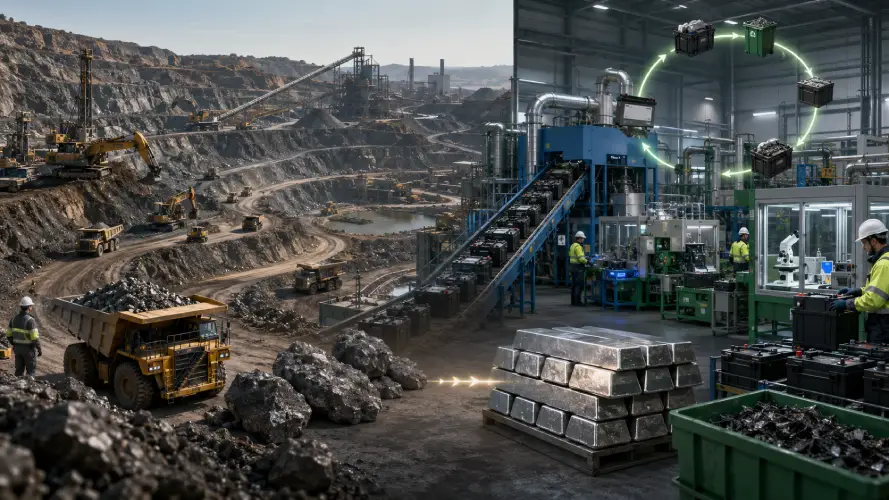
Lead has been extracted from the earth for over 2,000 years. For centuries, mining was the only source. Today, lead recycling has become an important source of lead alongside traditional mining , with profound implications for the environment, economy, and resource sustainability. The choice between recycling and mining represents a fundamental shift in how industries source materials - moving from extraction to recovery, from depletion to sustainability. Understanding the differences between lead recycling and mining is critical for understanding the future of resource management, circular economy principles, and how companies like Gravita India are contributing to more sustainable material sourcing through responsible recycling.
The Traditional Lead Mining Process
Traditional lead mining extracts lead ore (galena) from deep underground or surface deposits. Mining operations are massive capital-intensive projects requiring extensive infrastructure, equipment, and workforce. A single lead mine might operate for decades, extracting millions of tons of ore annually. The mining process involves drilling, blasting, excavating, transporting ore to processing facilities, and then crushing, concentrating, and smelting to produce lead metal.
The environmental impact is substantial. Mining disturbs large land areas, creating open pits or underground voids. Ore processing generates significant quantities of mining waste, with volumes depending on ore grade, mining practices and processing technology. This mining waste, called tailings, contains heavy metals and toxic compounds that threaten water supplies and ecosystems. Mining also consumes vast quantities of water, often in water-stressed regions. Energy consumption for drilling, blasting, excavation, transport, and smelting is substantial, typically powered by fossil fuels. Depending on its location and scale, mining operations can affect local communities, alter land use and impact surrounding ecosystems if not managed responsibly.
Lead Recycling Process
Lead recycling collects lead-acid batteries (the primary source), construction materials, automotive components, and industrial waste containing lead. Recycled material is transported to professional processing facilities where it is sorted, dismantled (batteries are opened and lead is separated from plastic, acid, and other materials), melted, refined, and cast into ingots. The entire process is performed at controlled facilities with environmental protections, worker safety systems, and quality control measures.
Lead-acid batteries are the dominant recycling source (over 90% of recycled lead). Modern collection systems systematically retrieve batteries from vehicles, equipment, and consumer sources. Battery recycling facilities have mature, proven technology. Modern recycling facilities are capable of achieving very high recovery efficiencies from spent lead-acid batteries, depending on technology and operating practices. The process generates minimal waste - plastic and acid components are recovered separately. The facility operates at a single location rather than disturbing mining sites. Environmental controls prevent atmospheric and water contamination.
Environmental Impact Comparison
Land Disruption: Mining: Permanent landscape alteration across millions of hectares globally. Excavation creates open pits, underground voids, and waste storage areas. Recycling: Operates at fixed facilities without landscape disruption. No mining sites, no habitat destruction.
Waste Generation: Mining: 50-100 tons of mining waste per ton of lead produced. Tailings contain toxic metals and acid, threatening water and soil. Recycling: Significantly lower waste generation compared to primary lead production, with waste streams managed under controlled conditions.
Water Consumption: Mining: Massive water consumption for ore processing in often water-stressed regions. Water contamination from tailings threatens downstream communities. Recycling: Use controlled systems to minimize water consumption and manage wastewater in accordance with environmental regulations.
Energy Consumption: Mining: Intensive energy for drilling, blasting, excavation, transport, and smelting. Typically powered by fossil fuels. Recycling: 50-60% less energy than mining. Uses electricity (increasingly renewable).
Air Quality: Mining: Dust from blasting and excavation impacts air quality across mining regions. Smelter emissions from ore processing. Recycling: Modern facilities use air pollution control systems to minimize emissions and comply with environmental regulations.
Ecosystem Impact: Mining: Habitat destruction, species displacement, ecosystem disruption lasting decades or centuries. Recycling: substantially lower direct impact on natural ecosystems compared to mining when operated responsibly.
Geopolitical Impact: Mining: Lead deposits in specific countries create geopolitical dependencies. Supply vulnerable to political instability, wars, embargoes. Recycling: Locally-sourced supply independent of geopolitical factors. Supply controlled by domestic recycling infrastructure.
Economic Comparison
Lead recycling is economically superior to mining across multiple dimensions. Recycled lead can often provide cost advantages over primary lead depending on market conditions, logistics, and material specifications. For manufacturers consuming thousands of tons annually, material cost savings reach millions of dollars.
Mining requires massive capital investment - developing a new lead mine typically requires substantial capital investment and several years before production begins. Operating costs are substantial: labor, equipment, energy, environmental compliance. Mining is also vulnerable to commodity price fluctuations, making revenue unpredictable. Recycling facilities require much lower capital investment), faster deployment, and provide stable supply independent of market fluctuations.
Supply chain economics favor recycling. Manufacturers working with professional recyclers like battery recycling companies in India can establish long-term contracts for stable pricing and guaranteed supply. Integrated operations - where manufacturers own recycling facilities to recover lead from end-of-life products - eliminate middleman costs and create completely circular systems. Compare this to mining, where supply depends on mined ore quality, mine production schedules, and global commodity prices.
Resource Depletion and Sustainability
Lead is a finite natural resource, while recycled lead can remain in productive use through repeated recycling when effective collection and recycling systems are in place. Lead can be recycled repeatedly without quality degradation, providing perpetual supply if collection and processing systems are maintained. This fundamental difference - finite extraction versus infinite recycling - defines the sustainability choice.
The circular economy framework emphasizes keeping materials in circulation rather than extracting new resources. Urban mining and professional material recovery operations embody this principle by systematically recovering lead and other materials from waste streams. Unlike mining, which depletes finite reserves, recycling builds cumulative material stocks - every recycled battery makes more lead available for future use without additional extraction.
Lead Recycling Rate and Market Reality
Global lead recycling rates are already substantial and growing. Lead-acid batteries achieve very high recycling rates. This means for every new battery produced, approximately one used battery is recycled - making lead one of the most successfully recycled industrial metals globally.
India represents a massive opportunity for improved recycling rates. Current collection and recycling infrastructure is developing, but opportunity exists to substantially increase recycling rates for lead-acid batteries and other lead-containing waste. Formal, regulated operations like battery recycling plants in India can capture value from waste streams, create jobs, and provide sustainable material supply for manufacturers.
Regulatory Momentum Favoring Recycling
Extended Producer Responsibility (EPR) schemes increasingly require manufacturers to manage end-of-life products. Lead-acid battery producers must ensure proper collection and recycling, creating greater emphasis on responsible collection and environmentally sound recycling. . This regulatory framework is expanding globally and strengthens recycling market economics.
Corporate sustainability commitments drive similar pressure. Major manufacturers publish goals to increase recycled material use, reduce virgin material extraction, and lower manufacturing carbon footprint. These commitments create competitive advantage for companies sourcing recycled lead and disadvantage for those dependent on mining. Investors increasingly favor companies with demonstrated sustainability, making recycling adoption a financial advantage.
Technological Advances in Lead Recycling
Lead recycling technology is continuously advancing. Modern battery recycling facilities achieve very high recovery rates from battery lead content through improved sorting, smelting, and refining processes. Advanced equipment sorts materials more efficiently, reducing waste. Digital tracking systems monitor material flows and improve collection rates. These technological advances make recycling increasingly efficient and cost-effective compared to mining.
Closed-loop manufacturing systems, enabled by closed loop manufacturing design principles, create integrated systems where products are designed for recovery, materials are systematically collected, recycled, and reused in new production. This represents the future of sustainable manufacturing - reducing dependence on the traditional linear extract-produce-discard model entirely.
Challenges in Scaling Recycling
· Infrastructure Development: Established mining is globally distributed with mature supply chains. Recycling infrastructure requires development, particularly in emerging markets like India.
· Collection Systems: High recycling rates require reliable collection to retrieve lead-containing waste. Building collection infrastructure requires investment and coordination.
· Quality and Consistency: Recycled lead quality equals primary lead, but manufacturers require consistent documentation. Recyclers must maintain rigorous quality systems.
· Market Awareness: Many manufacturers underestimate recycled lead quality. Market education accelerates adoption.
· Regulatory Frameworks: As EPR and circular economy regulations expand, companies must adapt procurement. Transition challenges are temporary but real.
Frequently Asked Questions
Why doesn't recycling completely replace mining?
Recycling is expanding rapidly, but mining persists due to infrastructure inertia, existing supply contracts, historical practice, and lead demand exceeding available recycled supply. As recycling infrastructure develops, mining will decline. Recycling already contributes a significant share of global lead supply.
Can recycled lead meet all global lead demand?
Theoretically yes, if collection infrastructure systematically captures lead-containing waste. Recycling is expected to play an increasingly important role alongside primary production.
What happens to mining areas after mines close?
Mining sites often remain degraded for decades. Restoration is expensive, incomplete, and rarely restores ecosystems to pre-mining conditions. Some become toxic environmental liabilities.
How does lead price affect the recycling vs mining choice?
When lead prices are high, recycling becomes more profitable. When prices are low, recycling margins shrink. However, recycled lead generally maintains cost advantage over primary lead due to lower energy requirements.
Is regulatory pressure forcing the shift to recycling?
Yes, increasingly. EPR schemes, carbon pricing, and sustainability mandates create regulatory advantages for recycling. Early adopters gain competitive advantage.
The Future: Mining Decline and Recycling Growth
The trend is clear. Lead recycling is expanding faster than mining as technology improves, infrastructure develops, and environmental regulations tighten. As recycling infrastructure expands and recovery technologies continue to improve, recycled lead is expected to account for an increasing share of future lead supply. Within three to four decades, primary mining may gradually reduce its relative share in markets where high recycling rates and effective collection systems are achieved.
This transition represents progress toward true circular economy - a system where materials flow continuously through production without depletion of finite resources or environmental destruction. Lead, with its exceptional recyclability and established recovery infrastructure, is leading this transition. Similar circular economy approaches are also being adopted for materials such as aluminium, copper, plastics, and steel.
Key Takeaways
Lead mining and lead recycling represent fundamentally different approaches to material sourcing. Mining extracts finite resources through environmentally destructive processes generating significantly higher environmental impacts, consuming vast energy, displacing communities, and creating geopolitical vulnerabilities. Lead recycling recovers materials from waste streams through controlled processes generating minimal waste, consuming 50-60% less energy, and creating sustainable supply chains independent of mining. Economically, recycled lead costs 15-30% less, requires lower capital investment, and provides more stable supply than mining. Environmentally, recycling significantly reduces waste generation, resource extraction and environmental impact compared with primary mining.. Regulatory momentum increasingly favors recycling through EPR schemes and sustainability mandates. For manufacturers, recycled lead offers an increasingly attractive option for manufacturers seeking reliable supply, sustainability, and long-term resource efficiency. . For Gravita India and professional recyclers globally, this trend represents enormous opportunity to expand operations, create jobs, and build sustainable material supply chains that serve manufacturers while protecting the environment. The transition from mining to recycling is underway. Within decades, recycling is expected to play an increasingly important role in the future supply of lead alongside responsibly managed primary production.