


 Share
Share
What Is Litharge? Red Lead, Lead Oxide & Lead Metal - Types, Industrial Uses & Applications in India
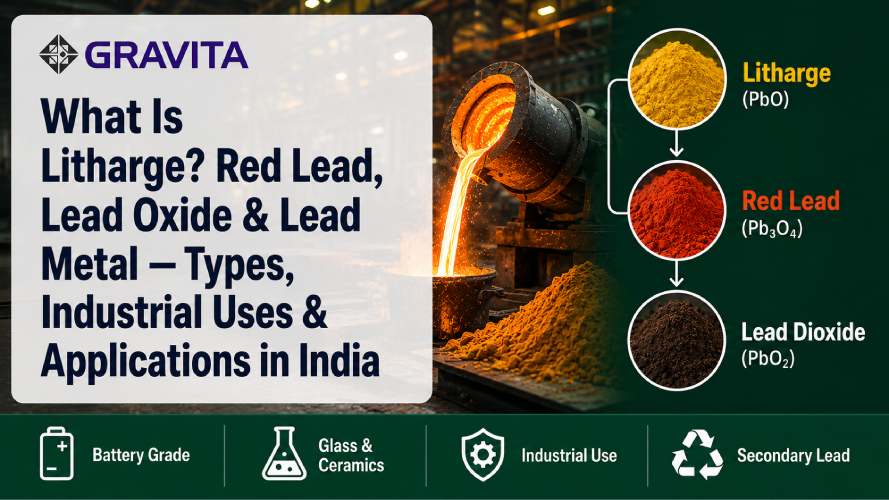
Litharge. You may have come across the term in a technical specification, a procurement inquiry, or a chemical product list - and wondered exactly what it means. In India's metals and manufacturing industry, litharge and its related compounds - red lead, lead dioxide, and various lead oxides remain important industrial raw materials used across a wide range of critical sectors.
From the batteries powering automobiles and inverters to the glass used in high-end optical instruments, lead oxide compounds play a role that is far more central to Indian manufacturing than most people realise. This guide explains what litharge is, the different types of lead oxide, how each is produced, and where they are used across Indian industry today .
What Is Litharge?
Litharge is the commercial name for lead(II) oxide, chemically represented as PbO. It is one of the most important lead compounds produced by secondary lead smelters and recyclers, including from the processing of used lead-acid batteries.
In its pure form, litharge appears as a yellow to red-orange powder or crystalline solid. It has a high density (approximately 9.53 g/cm³), a melting point of around 888°C, and excellent chemical reactivity that makes it useful as a raw material, a flux, and an active electrode material. Litharge is classified under HSN Code 2824 in India's GST framework, which covers lead oxides and lead peroxides.
Litharge belongs to a broader family of lead oxide compounds. Understanding the differences between these compounds - and knowing which one a particular application requires - is essential for procurement and formulation teams across Indian industry.
Types of Lead Oxide Compounds
1. Litharge - Lead(II) Oxide (PbO)
Litharge is the simplest and most widely produced form of lead oxide. It exists in two crystalline forms: alpha-PbO (tetragonal litharge, the most common commercial form) and beta-PbO (massicot, an orthorhombic form less commonly seen in industrial applications). The alpha form is the commercially relevant material used in battery paste, glass, and ceramics.
Chemical formula: PbO
Appearance: Yellow to red-orange powder
Density: 9.53 g/cm³
Purity: Typically 97–99.9% for industrial grades
Primary use: Battery active material (positive plate paste), glass formulation, ceramics
2. Red Lead - Lead(II,IV) Oxide (Pb₃O₄)
Red lead, also known as minium or lead tetroxide, is produced by the further oxidation of litharge. When litharge is heated in air at temperatures between 450°C and 500°C, it converts to the bright red compound Pb₃O₄. Red lead has historically been one of the most important industrial pigments and anti-corrosion primers in heavy engineering.
Chemical formula: Pb₃O₄
Appearance: Bright red to orange-red powder
Density: 8.73–9.10 g/cm³
Primary use: Anti-corrosion primers (steel structures, bridges, shipbuilding), glass, ceramics, stabilisers
3. Lead Dioxide - Lead(IV) Oxide (PbO₂)
Lead dioxide is the oxidised form of lead and functions as the active material on the positive plates of lead-acid batteries. It is dark brown to black in colour and is typically formed electrochemically within the battery during formation cycles rather than being separately supplied as a raw material in most applications.
Chemical formula: PbO₂
Appearance: Dark brown-black powder
Primary use: Lead-acid battery electrode material, oxidising agent in chemical synthesis
4. Lead Suboxide - Lead Sub-Oxide (Pb₂O / Grey Oxide)
Lead sub-oxide, also called grey oxide or leady oxide, is a mixed compound of lead and lead oxide (typically 65–75% PbO with remaining metallic lead). It is the principal active material in lead-acid battery paste formulations and is produced in specialised ball mills or Barton pot reactors.
Chemical formula: PbO·Pb (approximately)
Appearance: Fine grey powder
Primary use: Lead-acid battery paste - both positive and negative plate active material
How Is Litharge Manufactured in India?
In India, litharge is primarily produced as a downstream product at secondary lead smelting plants that process used lead-acid battery scrap. The production process involves the following stages:
Step 1 - Secondary Lead Smelting
Used lead-acid batteries are broken down and smelted to recover refined lead metal with purities of 99.97% or higher. This refined lead becomes the feedstock for lead oxide production.
Step 2 - Lead Oxidation (Ball Mill or Barton Pot Process)
Refined lead is fed into either a rotating ball mill or a Barton pot reactor. In a ball mill, friction from tumbling lead balls generates heat, causing the surface of the lead to oxidise into PbO. In a Barton pot, molten lead is agitated and exposed to air, producing lead oxide powder through a controlled oxidation reaction. Ball mill processes yield a mixture of lead sub-oxide (grey oxide), while Barton pot processes produce a more uniform litharge.
Step 3 - Thermal Processing for Red Lead
To produce red lead (Pb₃O₄), litharge is further oxidised in a rotary kiln or muffle furnace at temperatures between 450°C and 500°C in an excess air atmosphere. The conversion reaction is: 3PbO + ½O₂ → Pb₃O₄. Temperature control is critical - overheating converts red lead back to litharge.
Step 4 - Quality Analysis and Packaging
Finished oxide is sampled and tested for purity, free lead content, specific surface area (for battery grades), and particle size distribution. Products are packaged in moisture-proof HDPE bags or jumbo bags for dispatch.
Industrial Uses of Litharge and Red Lead in India
1. Lead-Acid Battery Manufacturing (Primary Application)
The single largest use of litharge and lead sub-oxide in India is in the manufacture of lead-acid batteries. India is among the world’s major lead acid battery markets , driven by the automotive sector (two-wheelers, passenger vehicles, commercial vehicles), the telecom infrastructure sector, UPS and inverter systems, and the rapidly expanding grid-connected solar power sector.
In battery manufacturing, lead oxide is mixed with sulphuric acid and water to form a paste that is applied to battery grids. After curing and formation charging, this paste becomes the active electrode material responsible for the battery's energy storage capacity. The quality and purity of the lead oxide directly determine battery performance and cycle life.
India's battery industry consumes substantial volumes of lead oxide annually. Understanding the role of used lead-acid battery scrap in India's recycling industry is essential context - because the lead oxide used in today's batteries frequently originates from recycled batteries processed at authorised smelters.
2. Glass Manufacturing
Litharge is a critical flux and clarifying agent in specialty glass production. Lead crystal glass - used in optical instruments, decorative items, and high-end tableware - relies on litharge to lower the glass melting temperature, increase the refractive index, and improve brilliance and workability. Optical glass for camera lenses, microscopes, and scientific instruments requires high-purity litharge with tightly controlled iron and bismuth contamination levels.
India's growing optical and electronics manufacturing sector, supported by the Production Linked Incentive (PLI) schemes, is increasing domestic demand for glass-grade litharge.
3. Ceramics and Glazes
Lead oxide is used in ceramic glazes and frits to lower the firing temperature, improve gloss, and enhance colour development. Both litharge and red lead are used in specific ceramic formulations. India has a large traditional ceramics sector alongside an industrial technical ceramics industry that uses lead-bearing frits for specific applications.
4. Anti-Corrosion Primers and Paints (Red Lead)
Historically, red lead (Pb₃O₄) was widely used as an anti-corrosion pigment for steel structures and heavy industrial applications. Today, its use is limited and governed by regulatory controls, with several industries transitioning toward alternative coating technologies. However, certain specialised industrial applications may continue to use lead-based formulations under controlled conditions and applicable regulations.
5. Rubber and PVC Stabilisers
Litharge acts as a heat stabiliser and vulcanisation accelerator in specific rubber compound formulations. In PVC processing, lead stabilisers - including dibasic lead sulphate and tribasic lead sulphate, which are derivatives of lead oxide - have historically been used to prevent degradation of PVC at processing temperatures. Lead-based stabilisers have historically been used in PVC processing applications, although many manufacturers are increasingly shifting toward alternative stabiliser systems in response to evolving environmental and regulatory standards..
6. Chemical Synthesis and Specialty Applications
Lead oxide is used as a catalyst or reagent in organic synthesis. It has applications in the production of certain dyes, electrolytic processes, and specialised metallurgical applications. Red lead is also used in the manufacture of certain types of glass, particularly radiation-shielding glass.
Understanding Lead Metal in India
Lead metal (Pb) - in its refined, alloyed, and remelted forms - is the upstream material from which all lead oxide compounds are derived. India produces refined lead primarily through the secondary route: recovering lead from used lead-acid battery scrap at authorised recycling facilities.
Refined lead from secondary smelters typically achieves purities of 99.97% to 99.99% (termed pure lead or soft lead). From this, various alloy grades are produced for specific applications:
Lead Grade / Form | Composition | Primary Application |
Pure Lead / Soft Lead (99.97%) | Pb ≥ 99.97% | Lead oxide production, chemical industry, radiation shielding |
Antimonial Lead | Pb + Sb (1–12%) | Battery grids, cable sheathing, sheet and pipe |
Calcium Lead | Pb + Ca (0.03–0.08%) | VRLA and maintenance-free battery grids |
Selenium Lead | Pb + Se | Specialty battery and alloy applications |
Remelted Lead Ingots | Pb ≥ 97–98% | Secondary processing, casting applications |
Why Recycled Lead Oxide Performs Identically to Virgin-Grade Material
A common misconception in procurement is that secondary (recycled) lead oxide is inferior to primary-grade material. When refined and processed under controlled manufacturing standards, secondary lead can achieve specifications comparable to primary-grade material.Secondary lead smelters like Gravita India use spectroscopic analysis and controlled refining to produce refined lead of 99.984% purity or higher - the same specification as primary lead - before converting it to lead oxide. The final oxide quality depends primarily on refining controls, purity standards, and manufacturing processes.
Battery manufacturers, glass producers, and ceramics companies in India routinely qualify and purchase secondary-grade litharge and red lead that meets their specification requirements. Using secondary lead oxide also supports India's circular economy objectives and reduces the environmental cost of virgin lead mining.
Understanding how scrap material feeds into this cycle is important. If you're looking to sell used batteries or lead scrap, our guide on how to find trusted and certified scrap buyers near you covers what to look for in a compliant recycling partner.
Regulatory Compliance for Lead Compounds in India
The production, handling, storage, and sale of lead compounds in India is governed by several regulatory frameworks:
Battery Waste Management Rules (BWMR) 2022 - governs the collection and recycling of lead-acid batteries, the primary feedstock for secondary lead oxide production
Hazardous Waste Management Rules - lead smelting slag and process residues are classified as hazardous waste requiring compliant disposal
Lead Paint (Restriction) Rules, 2016 - caps lead in decorative paints at 90 ppm; industrial applications are separately governed
BIS Standards - IS 1013 covers litharge specifications; IS 999 and IS 57 cover related lead and alloy standards
REACH and Export Compliance - for exporters, EU REACH regulations restrict lead compounds in consumer products
Key Industries Buying Litharge and Red Lead in India
Lead-acid battery manufacturers (automotive, industrial, telecom)
Specialty glass and crystal glass manufacturers
Industrial coatings and anti-corrosion primer manufacturers
Technical ceramics and glaze producers
PVC and rubber compound manufacturers
Specialty chemical manufacturers
Radiation shielding material manufacturers
Frequently Asked Questions (FAQ)
What is the difference between litharge and red lead?
Litharge is lead(II) oxide (PbO) - a yellow to orange powder produced by the direct oxidation of lead. Red lead is lead tetroxide (Pb₃O₄), produced by the further oxidation of litharge at higher temperatures. They have different chemical structures, appearances, and industrial applications. Litharge is primarily used in battery manufacturing and glass; red lead is used mainly in anti-corrosion primers and specialty glass.
Is litharge the same as lead monoxide?
Yes. Litharge and lead monoxide are both names for PbO. "Litharge" is the commercial and mineralogical term, while "lead monoxide" or "lead(II) oxide" is the IUPAC chemical name for the same compound.
What is the HSN code for litharge in India?
Litharge (PbO) and red lead (Pb₃O₄) are classified under HSN Code 2824 - "Lead oxides; red lead and orange lead" - under India's GST structure. Applicable GST rates are subject to prevailing tax regulations .
Is recycled litharge (from secondary lead) the same quality as primary litharge?
Yes - when produced from properly refined secondary lead of 99.97% purity or above, recycled litharge meets the same specification as primary-grade material. Battery manufacturers in India routinely use secondary-grade litharge that meets IS 1013 or customer-specific specifications.
What is the typical purity of battery-grade litharge?
Battery-grade litharge typically requires a minimum 97% PbO content for standard applications and up to 99%+ for premium battery paste formulations. Specific surface area (m²/g), free lead content (maximum 3%), and moisture levels are also controlled parameters in battery-grade procurement specifications.
Which Indian states have the most litharge manufacturing activity?
Rajasthan), Gujarat, Tamil Nadu and Uttar Pradesh have significant secondary lead smelting and lead oxide manufacturing activity in India. Most producers are authorised recyclers under the Battery Waste Management Rules.
Conclusion
Litharge, red lead, and their related lead oxide compounds are essential industrial raw materials that underpin critical sectors of the Indian economy - from the battery industry that powers vehicles, telecom infrastructure, and renewable energy storage, to the glass and ceramics sectors that supply everything from optical instruments to high-end tableware.
India's secondary lead industry - which recovers lead from used batteries and converts it into high-purity refined lead and lead oxide - is a fundamental part of this supply chain. Recycled litharge and red lead meet industry specifications, support circular economy goals by enabling material recovery and reuse. For procurement teams, quality managers, and specification engineers: understanding which grade of lead oxide your application requires, and sourcing from a compliant, quality-assured manufacturer, is the starting point. For sellers of lead scrap and used batteries, working with an authorised recycler ensures compliance and fair pricing.
About Gravita India
Gravita India is one of the country's leading secondary lead smelters and lead product manufacturers, with operations across India, Africa, and Southeast Asia. Gravita produces litharge, red lead, lead sub-oxide, pure lead, lead alloys, lead sheets, lead plates, and remelted lead ingots from responsibly sourced recycled feedstock. All products are manufactured at CPCB-authorised facilities and meet applicable BIS and customer specifications.
Looking to source litharge, red lead, or other lead products? Contact Gravita India today for current pricing, product specifications, and supply capability.