


 Share
Share
Lead Sheet vs Lead Bricks for Nuclear & Industrial Radiation Shielding: Which to Choose?
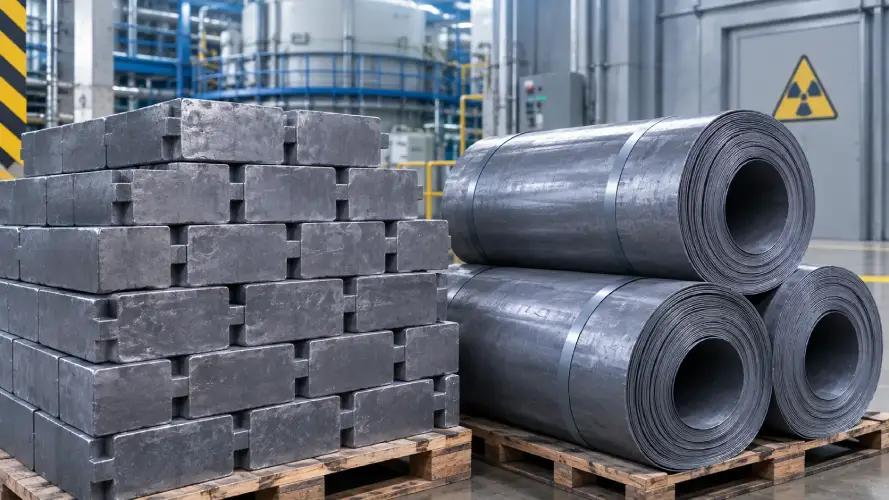
Once you move beyond diagnostic imaging rooms into nuclear facilities, research labs, industrial radiography sites, and gamma-spectroscopy setups, the shielding decision gets more complex. It's no longer just about picking a material - it's about choosing the right format of lead for the specific geometry, radiation source, and operational requirements of the site.
Two formats dominate nuclear and industrial shielding: lead sheet and lead bricks. Both are pure lead, both attenuate radiation effectively, but they behave very differently once you get into installation, flexibility, and total project cost. This guide breaks down when each format makes sense.
The Core Difference: Fixed vs Flexible Shielding
The simplest way to think about the choice is this: lead bricks are for shielding you might need to move, modify, or dismantle. Lead sheet is for shielding that becomes a permanent part of a structure.
Lead bricks are individually cast, standardised units (commonly interlocking, brick-shaped or step-shaped) that are stacked to build a shield - around a source, a piece of equipment, or a temporary work area. Because they're modular, they can be reconfigured, added to, or removed without demolishing anything.
Lead sheet, by contrast, is a continuous rolled material that's bonded or fixed to a wall, door, or panel to create a permanent radiation barrier as part of the building or enclosure itself.
Lead Bricks: Where They Make Sense
Gamma spectroscopy and lab shielding castles. In labs running gamma-ray detection, lead bricks are used to build "castles" - enclosed shielding structures around a detector to block environmental background radiation. Because detector setups change, the ability to reconfigure the shield without new construction is essential.
Temporary or mobile shielding. Industrial radiography (non-destructive testing) often requires shielding to be set up at different job sites or around a mobile radiation source. Bricks can be transported, stacked at one location, and re-stacked at another.
Hot cell and source-handling shielding. Facilities that need to isolate or shield around active sources during handling, storage, or transfer often use brick shielding for the flexibility to build around irregular equipment shapes.
Storage and interim shielding needs. Where a facility needs shielding around a specific point source or piece of equipment on an interim basis - before permanent construction is finalised, or for a short-term project - bricks avoid the cost and irreversibility of permanent installation.
Lead Sheet: Where It Makes Sense
Permanent wall, floor, and ceiling lining. For nuclear facility rooms, hot labs, and any space requiring continuous, gap-free shielding across a large surface area, lead sheet bonded to backing material (plywood, gypsum, steel) is the standard approach.
Door and viewing window shielding. Sheet lead is used to line shielded doors and can be incorporated around lead glass viewing windows, since it can be cut and fitted to non-standard shapes and openings.
Duct, pipe, and penetration shielding. Where cables, pipes, or ducts pass through a shielded wall, lead sheet can be wrapped or fitted around penetrations in ways that rigid brick geometry cannot easily achieve.
Large-area industrial enclosures. For permanently shielding a large room, corridor, or enclosure - such as around a fixed industrial irradiator or a permanent radiography bay - sheet lining is generally more space- and cost-efficient than building brick walls of equivalent shielding value.
Comparing the Two Formats
Factor | Lead Sheet | Lead Bricks |
Best suited for | Permanent walls, doors, large enclosures | Temporary, mobile, or reconfigurable shielding |
Installation | Bonded to backing material; skilled but one-time labour | Stacked/interlocked; can be assembled and disassembled repeatedly |
Flexibility | Fixed once installed | Fully reusable and reconfigurable |
Handling gaps/penetrations | Easily cut and fitted around openings | Requires custom-cut bricks or additional sealing at irregular shapes |
Space efficiency | Thinner overall footprint for large flat surfaces | Bulkier due to interlocking joints and stacking tolerances |
Typical use case | Hospital rooms, nuclear facility walls, shielded doors | Lab shielding castles, mobile NDT shielding, source handling |
Reusability across projects | Not reusable once installed | High - can be redeployed at new sites or reconfigured |
Factors That Should Drive Your Decision
Permanence of the installation. If the shielded space is a fixed part of your facility that won't change, sheet is almost always more cost-efficient per unit of shielded area. If the shielding needs to move with equipment, projects, or sources, bricks are the only practical option.
Geometry complexity. Irregular shapes, curved surfaces, doors, and penetrations favour sheet, which can be cut to fit. Rectilinear, modular shielding around a defined source or work zone favours bricks.
Budget and lifecycle cost. Lead bricks offer greater flexibility for applications that may require future reconfiguration or relocation, while lead sheet is generally well suited to permanent installations. The most economical option depends on the project design, installation requirements and potential for future reuse.
Regulatory design specification. As with hospital shielding covered in our related guide on lead sheets for radiation shielding in hospitals and diagnostic centres, nuclear and industrial shielding projects are governed by a design report from a radiation safety consultant or AERB-recognised authority. In many cases, the shielding format is specified as part of that design - bricks and sheet are not always interchangeable once a design has been approved for a specific configuration.
Can the Two Be Combined?
Yes - and in many nuclear and industrial facilities, they are. A common approach is permanent sheet lining for walls, floors, and doors, combined with brick shielding for specific equipment, source storage points, or work areas that need flexibility within that permanently shielded room. Choosing between the two isn't always an either/or decision; it's about matching the right format to each part of the facility's shielding requirement.
Sourcing Lead Sheet and Bricks From a Single Supplier
Working with a manufacturer that produces both formats - rather than sourcing sheet and bricks from separate vendors - simplifies procurement and ensures consistent lead purity across a facility's entire shielding installation. Gravita India manufactures lead sheet and other lead alloy products from an integrated lead recycling and refining operation, offering the same quality control standards across both sheet and cast lead products.
Frequently Asked Questions
Is lead brick shielding as effective as lead sheet for the same thickness?
Yes - attenuation depends on the density and thickness of lead in the radiation path, not the format. The difference between bricks and sheet is installation flexibility and permanence, not shielding effectiveness at equivalent thickness.
Can lead bricks be used for permanent wall shielding instead of sheet?
Technically yes, but it's rarely cost-efficient for large flat surfaces - brick walls require more material and labour for joints and interlocking compared to a continuous sheet of equivalent shielding value.
Do nuclear facilities typically use both lead sheet and lead bricks?
Yes, most facilities use sheet for permanent structural shielding (walls, doors) and bricks for flexible shielding around equipment, sources, or work areas that may need to be reconfigured.
Does recycled lead affect the shielding performance of bricks or sheet?
No. Once refined to the required purity, recycled lead performs identically to primary lead in both brick and sheet form - shielding effectiveness depends on density and thickness, not the source of the raw material.
Need lead sheet or lead bricks for a nuclear, industrial, or laboratory shielding project? Connect with Gravita's lead products team for specifications and pricing.