


 Share
Share
Lead Sheet & Lead Plate in India: Thickness Grades, Industrial Uses, Radiation Shielding & Buying Guide
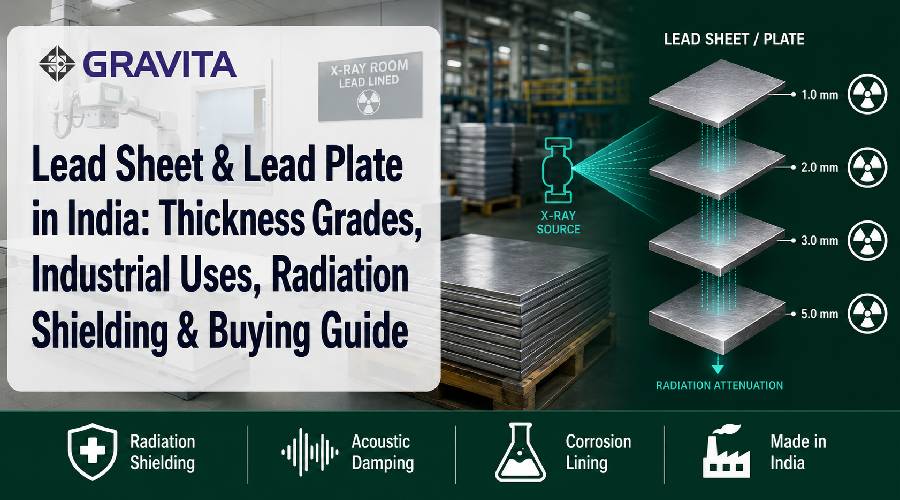
Lead sheet and lead plate are among the most specialised and widely relied-upon forms of manufactured lead in industrial India. Their unique combination of high density, ductility, chemical inertness, and radiation-attenuating properties makes them widely used in applications ranging from hospital X-ray rooms and nuclear facilities to marine construction, acoustic engineering, and high-voltage cable systems.
Yet for many procurement engineers and project managers, navigating the different grades, thickness specifications, alloy options, and quality parameters of lead sheet and plate can be complex. This guide covers everything you need to know - from material specifications and industrial applications to radiation shielding performance and a practical buying guide for Indian sourcing.
What Are Lead Sheets and Lead Plates?
Lead sheet and lead plate are flat, rolled products manufactured from refined lead or lead alloys. While the terms are often used interchangeably, there is a useful practical distinction:
Lead Sheet - typically refers to thinner material, ranging from 0.5 mm to approximately 6 mm in thickness. Lead sheet is highly flexible and workable, making it easy to cut, fold, and shape on-site.
Lead Plate - generally refers to thicker material, from approximately 6 mm upward to 25 mm or more. Lead plates are more rigid and are specified where structural rigidity, high radiation shielding equivalence, or significant physical protection is required.
Both are manufactured by rolling lead billets or cast lead through a series of rolling mills to achieve the target thickness and surface finish. Width and length are typically cut to standard sizes or customised to project requirements.
How Lead Sheet Is Manufactured
The manufacturing process for lead sheet starts at the lead smelting plant, where refined or alloyed lead is produced from either primary ore or secondary recycled feedstock. The downstream sheet manufacturing process involves:
Casting - Molten lead or lead alloy is poured into book moulds or continuous casting machines to produce cast slabs of controlled weight and dimensions.
Rolling - The cast slabs are passed through rolling mills at controlled temperatures and pressures to reduce thickness progressively toward the target gauge.
Annealing - For thinner gauges, intermediate annealing may be required to restore ductility and prevent work-hardening cracking.
Cutting and Sizing - Rolled sheet is cut to standard widths and lengths or custom dimensions using guillotine shears.
Quality Inspection - Finished sheet is inspected for thickness uniformity, surface defects, dimensional accuracy, and weight-per-unit-area (kg/m²).
Standard Thickness Grades and Specifications
Lead sheet in India is specified by thickness (mm) and corresponding surface weight (kg/m²). The relationship between the two is linear, based on lead's density of approximately 11.34 g/cm³. The table below provides a reference for standard commercial grades:
Thickness (mm) | Surface Weight (kg/m²) | Lead Equivalence (mmPb) | Typical Application |
0.5 mm | 5.7 kg/m² | 0.5 mmPb | Light radiation shielding overlays, lining |
1.0 mm | 11.3 kg/m² | 1.0 mmPb | X-ray room lining, dental radiology |
1.5 mm | 17.0 kg/m² | 1.5 mmPb | Medical X-ray rooms, fluoroscopy suites |
2.0 mm | 22.7 kg/m² | 2.0 mmPb | “CT scan shielding and ancillary radiation protection |
3.0 mm | 34.0 kg/m² | 3.0 mmPb | Linear accelerator (LINAC) rooms, nuclear labs |
5.0 mm | 56.7 kg/m² | 5.0 mmPb | Industrial radiography, gamma testing facilities |
6.0 mm+ | 68+ kg/m² | 6.0+ mmPb | Nuclear waste storage, hot-cell construction |
10–25 mm (plate) | 113–283 kg/m² | 10–25 mmPb | High-energy gamma shielding, reactor components |
Note: The "mmPb" (millimetres of lead equivalence) is the standard unit used in radiation shielding design. A radiation physicist or medical physicist specifies the required lead equivalence for a room; the sheet manufacturer then supplies product to that specification.
Lead Alloys Used in Sheet and Plate Manufacturing
Not all lead sheet is made from pure lead. Depending on the application, different alloy grades are specified:
Alloy Grade | Composition | Key Properties | Applications |
Pure Lead (99.97%) | Pb ≥ 99.97% | Maximum corrosion resistance, high ductility | Chemical plant lining, radiation shielding, acid baths |
Antimonial Lead (2–8% Sb) | Pb + Sb | Higher hardness and strength vs pure lead | Structural plates, cable sheathing, battery grids |
Calcium Lead | Pb + Ca (0.03–0.1%) | Improved creep resistance | Cable sheathing, specialty plates |
Tellurium Lead | Pb + Te | Superior fatigue resistance, better machinability | Chemical plant applications, precision machined parts |
Industrial Uses of Lead Sheet and Lead Plate in India
1. Radiation Shielding (Primary Application)
The largest and most technically demanding use of lead sheet in India is radiation shielding. India's healthcare sector has expanded dramatically - with thousands of diagnostic imaging centres, cancer treatment facilities, and nuclear medicine departments across tier-1 and tier-2 cities. Each one requires certified radiation shielding in its walls, floors, and ceilings.
Lead sheet is the preferred radiation shielding material because:
It has a very high density (11.34 g/cm³), enabling effective radiation attenuation per unit thickness
It is flexible enough to line irregular surfaces, wrap around pipes, and be installed in awkward geometries without specialised fabrication
It does not degrade over time under normal radiation doses in diagnostic settings
It can be installed behind drywall, plaster, or timber framing without significantly increasing wall thickness
It is cost-effective compared to alternative heavy concrete or composite shielding materials at equivalent lead equivalence
Radiation Shielding Applications by Facility Type
Diagnostic X-Ray Rooms
General diagnostic X-ray rooms in India typically specify 1.0 to 1.5 mmPb for walls, with the exact value determined by a medical physicist based on the X-ray unit's kVp rating, workload, and the occupancy of adjacent spaces. The AERB (Atomic Energy Regulatory Board) and Bureau of Indian Standards specify minimum shielding requirements for different facility types.
CT Scan Rooms
CT scanners are significantly more radiation-intensive than conventional X-ray units. Primary barriers (walls in the X-ray beam path) for CT rooms typically require 2.0 to 3.0 mmPb or higher, while secondary barriers and the control booth may specify 1.0 to 2.0 mmPb.
Fluoroscopy and Interventional Radiology Suites
Fluoroscopy generates continuous X-ray exposure rather than brief exposures, leading to higher shielding requirements. Lead sheet of 1.5 to 2.5 mmPb is typically specified, with additional lead glass viewing windows and lead-lined doors with overlapping seals.
Radiation Oncology / Linear Accelerator (LINAC) Rooms
Medical linear accelerators used in cancer treatment generate high-energy photon beams at energies of 6 MV to 18 MV or higher. At these energies, lead shielding must be combined with concrete - lead plate is used at doorways, maze walls, and high-dose areas where concrete thickness alone would be impractical. Lead plate may be used in selected high-dose areas, doors, and specialised shielding applications within LINAC facilities, depending on the shielding design approved by the project physicist.
Nuclear Medicine and PET-CT Departments
Nuclear medicine uses radiopharmaceuticals that emit gamma radiation. Hot labs, dose calibrator rooms, patient injection areas, and waiting areas all require shielding. Lead sheet of 2.0 to 3.0 mmPb in walls and lead-lined storage containers are standard. PET-CT facilities, which handle high-energy 511 keV annihilation photons, require thicker shielding - typically 3.0 to 5.0 mmPb.
Industrial Radiography Facilities
Non-destructive testing (NDT) using industrial X-ray machines and gamma-ray sources (Iridium-192, Cobalt-60) requires heavy shielding. Bunkers and shielded enclosures for industrial radiography typically use thick lead plate (5–15 mm) combined with concrete construction.
2. Acoustic and Vibration Damping
Lead sheet's high density and viscoelastic properties at room temperature make it an effective material for sound isolation and vibration damping. Lead-lined drywall panels, acoustic enclosures for industrial machinery, marine bulkheads, and generator room linings use lead sheet to reduce noise transmission.
In India, lead acoustic solutions are used in:
Power plant and generator enclosures
Commercial HVAC duct lining
Marine and naval vessel bulkheads
Studio and auditorium construction (in combination with other acoustic materials)
Defence and sensitive installation noise isolation
3. Chemical Plant Lining and Corrosion Protection
Pure lead offers strong corrosion resistance in certain sulphuric acid and chemical processing applications. Lead sheet is used to line:
Acid storage tanks and pickling baths
Sulphuric acid plant equipment, sumps, and drainage channels
Electroplating tanks and electrolytic cells
Chlor-alkali and fertiliser plant corrosion-resistant surfaces
India's large chemical manufacturing sector - including fertiliser plants, acid producers, and electrochemical facilities - is a significant market for chemical-grade pure lead sheet.
4. Cable Sheathing
Extruded lead and lead-alloy sheaths are applied over high-voltage underground cables and submarine power cables to provide moisture impermeability, mechanical protection, and electromagnetic shielding. While polymeric cable sheaths have replaced lead in many applications, lead remains the specification material for certain high-voltage transmission cables, especially in underground and submarine installations.
5. Construction Applications
Lead sheet has specific construction applications including:
Roof flashing, valley lining, and weatherproofing at joints and penetrations (particularly in institutional and heritage buildings)
Lead-lined joints and interfaces in nuclear and specialised facilities
Lead wool and lead sheet for pipe penetration sealing in radiation areas
Counterweights and ballast in construction lifting equipment
Recycled Lead Sheet vs Virgin Lead Sheet - Is There a Difference?
For most applications, high-quality recycled lead sheet is technically equivalent to virgin-grade material. The key factor is the purity of the refined lead used as the starting material for sheet production. When secondary lead is refined to 99.97% purity - as is standard at authorised smelters like Gravita India - the downstream lead sheet produced from it meets the same chemical and mechanical specifications as sheet made from primary lead.
Radiation shielding equivalence (mmPb) is determined entirely by density and thickness, not by the origin of the lead. A 2.0 mm sheet of 99.97% secondary lead provides equivalent radiation shielding performance when manufactured to the required purity and density specifications.
Understanding how secondary lead is recovered from used battery scrap gives procurement teams confidence in the traceability and quality of recycled lead products.
Lead Sheet Buying Guide for India (2026)
Step 1 - Define Your Technical Requirements
Before approaching a supplier, document:
Required thickness (mm) or lead equivalence (mmPb) - from your radiation physicist's report or engineering specification
Alloy grade (pure lead 99.97%, antimonial, or other)
Sheet or plate dimensions (standard or custom-cut)
Surface finish requirements (as-rolled, or milled)
Quantity and delivery timeline
Applicable standards (BIS, ASTM, BS, or customer-specific specification)
Step 2 - Verify Supplier Authorisation and Compliance
In India, lead sheet manufacturers who produce from secondary lead must hold authorisation under the Hazardous Waste (Management and Transboundary Movement) Rules and the Battery Waste Management Rules. Verify:
CPCB/SPCB authorisation for the manufacturing facility
ISO 9001 or relevant quality certifications
Test certificates and material traceability documentation
GST registration and compliance (important for B2B procurement)
Step 3 - Request Material Test Certificates
For any structural or radiation shielding application, request a Material Test Certificate (MTC) confirming the lead purity, alloy composition, thickness measured by ultrasonic or mechanical gauge, and density. Radiation shielding projects additionally benefit from a batch-traceable certificate that can be submitted with your AERB or hospital authority documentation.
Step 4 - Evaluate Total Cost, Not Just Unit Price
Lead sheet pricing in India is typically quoted per kilogram or per m² at a given thickness. When comparing suppliers, factor in:
Minimum order quantities (MOQ)
Custom cutting charges if non-standard sizes are needed
Freight from the manufacturing location to your project site
Payment and credit terms
Lead time - critical for construction and hospital projects with fixed handover dates
Frequently Asked Questions (FAQ)
What thickness of lead sheet is required for an X-ray room in India?
The required lead equivalence for an X-ray room in India is determined by a qualified medical physicist based on the X-ray unit's kVp, workload (mA-minutes per week), use factor, and the occupancy of adjacent areas. As a general reference, diagnostic X-ray rooms commonly specify 1.0 to 1.5 mmPb for walls. The AERB Safety Code AERB/RF-MED/SC-1 provides the applicable requirements for medical facilities in India. Always commission a site-specific radiation shielding design before specifying materials.
What is the difference between lead sheet and lead plate?
Lead sheet typically refers to thinner material (0.5–6 mm) that is flexible and workable for lining and shielding applications. Lead plate refers to thicker material (6 mm and above) that has greater rigidity and is used in high-energy shielding and structural applications. The distinction is practical rather than formally standardised, and usage varies between suppliers.
Is lead sheet from recycled lead safe for radiation shielding?
Yes. Radiation shielding effectiveness depends on the density and thickness of the lead, not its origin. High-purity secondary lead (99.97%+) produces lead sheet with identical density and attenuation properties to virgin-grade material. All material should be supplied with a test certificate confirming purity and thickness.
Can lead sheet be cut and shaped on-site?
Yes. Lead sheet up to approximately 3 mm can be cut with tin snips or a sharp knife. Thicker material requires guillotine shears or a circular saw with a carbide blade. Lead is a soft metal and can be bent, folded, and shaped around corners. Installers should use appropriate PPE and follow safe lead handling procedures to prevent lead dust inhalation or ingestion.
Where are lead sheet manufacturers located in India?
Lead sheet manufacturers are concentrated in states with secondary lead smelting activity - primarily Rajasthan (Jaipur and surrounding districts), Gujarat, Tamil Nadu, and the Delhi NCR region. Gravita India, headquartered in Jaipur, Rajasthan, is one of India's largest integrated secondary lead processors and lead product manufacturers, with the capability to supply lead sheet, lead plate, and custom lead fabrications with full material traceability.
Conclusion
Lead sheet and lead plate are precision industrial materials with well-defined technical specifications and demanding end-use applications. In India's rapidly growing healthcare sector, nuclear industry, chemical manufacturing, and construction space, properly specified and quality-assured lead sheet is not a commodity - it is a safety-critical material that must be sourced with care.
Understanding the thickness grades, alloy options, and application requirements covered in this guide is the first step toward confident lead sheet procurement. Working with an authorised, ISO-certified manufacturer who can provide full material traceability and test certification is equally important.
The secondary lead production chain - from used battery scrap collection through smelting, refining, and downstream product manufacturing - ensures that India has a sustainable, domestic supply of high-quality lead sheet for all industrial needs.
Lead products should always be handled, installed and disposed of in accordance with applicable environmental, occupational health and radiation safety regulations. Appropriate PPE, ventilation and handling procedures should be followed during fabrication and installation.
About Gravita India
Gravita India manufactures and supplies a comprehensive range of lead products including lead sheet, lead plate, lead pipe, lead bricks, lead blankets, lead balls, pure lead ingots, lead alloys, litharge, and red lead. With CPCB-authorised facilities and integrated secondary lead smelting operations, Gravita delivers quality-certified lead products with full traceability to customers across India and globally.
Looking to source litharge, red lead, or other lead products? Contact Gravita India today for current pricing, product specifications, and supply capability.