


 Share
Share
Lead Recycling Plant vs Battery Recycling Plant: Which Turnkey Project Should You Invest in for India in 2026?
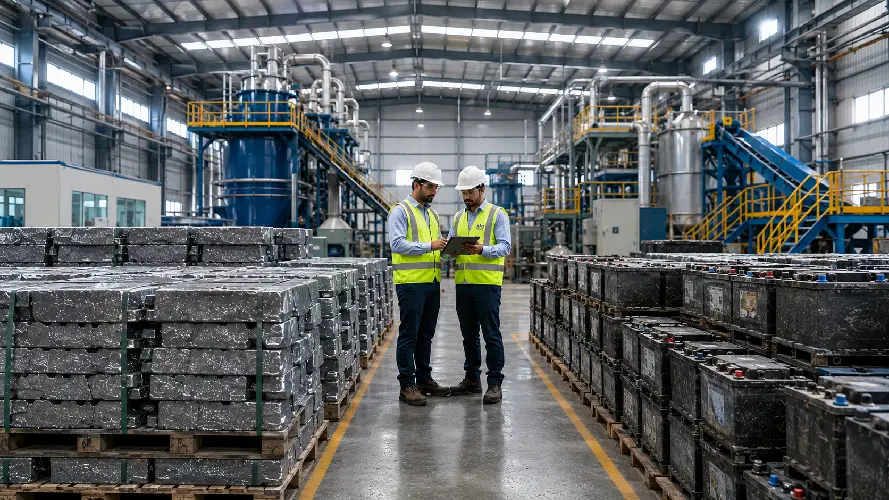
If you are evaluating a greenfield investment in India's recycling sector, two project types come up consistently as high-potential opportunities: a lead recycling plant and a battery recycling plant. Both operate in the same broad ecosystem - secondary lead and hazardous waste processing - but they are meaningfully different in scope, capital requirement, raw material access, regulatory complexity, and return profile.
The confusion between the two is understandable. At a surface level they look similar: both involve processing used lead-acid batteries, both produce refined lead as a primary output, and both require environmental clearances and CPCB authorisation. But the overlap ends there. A battery recycling plant is a complete processing operation that handles the entire battery - breaking it down into lead, acid, polypropylene, and other recoverable materials. A lead recycling plant typically starts downstream of that process, working with lead paste, lead bullion, or partially processed lead scrap as its raw material input.
Which one is the right investment for you in 2026 depends on your available capital, the raw material access you can realistically secure, your regulatory appetite, your target margin structure, and whether you want to operate as an upstream processor or a downstream refiner. This guide works through each of those dimensions in detail so you can make an informed decision - or understand why combining both into an integrated operation is often the answer serious investors land on.
The Indian Market Context: Why Both Projects Are Compelling Right Now
Before comparing the two models, it is worth understanding why 2026 is a particularly strong time to be evaluating either investment.
India is one of the world's largest consumers of lead-acid batteries. Every passenger vehicle, commercial truck, two-wheeler with electric start, inverter system, UPS, and industrial equipment unit uses one. The country's total lead-acid battery market is estimated to be growing at 7–9% annually, driven by the expanding vehicle fleet, rising power backup penetration in tier 2 and tier 3 cities, and grid storage requirements for renewable energy integration. Every one of those batteries eventually becomes scrap - typically within 2–5 years of manufacture.
Recycled lead now accounts for 70–85% of India's total lead consumption. The country imports virtually no primary lead ore in meaningful quantities; the domestic supply chain is built almost entirely on secondary lead from recycled batteries. This creates a structurally captive raw material supply and a structurally captive output market simultaneously - a combination that is genuinely rare in Indian manufacturing.
The Battery Waste Management Rules, 2022 have added a regulatory tailwind that did not exist in prior years. Under the EPR framework, battery producers and importers are legally required to demonstrate that a defined percentage of the batteries they sell are collected and recycled through CPCB-authorised facilities. Those recovery targets are rising annually. This means formal, registered recyclers are not just competing on economics - they are increasingly a compliance necessity for the battery industry's own upstream producers. Scrap flows to authorised recyclers with EPR agreements are becoming more predictable and more contractually secured than they were under the informal sector-dominated model of five years ago.
The result is that both lead recycling plants and battery recycling plants are operating in a favourable demand environment. The question is which model suits your specific position.
What Is a Battery Recycling Plant? What Does It Actually Do?
A battery recycling plant - specifically a lead-acid battery recycling plant in the Indian context - is an upstream processing operation. Its job is to take whole used lead-acid batteries as input and separate them into their component recoverable materials: lead compounds (primarily lead paste and lead grids), sulphuric acid, and polypropylene plastic casing.
The core process stages in a lead-acid battery recycling plant are:
Battery breaking and separation: Whole batteries are mechanically broken - either by a semi-automatic or fully automatic battery breaker - and the contents are separated into lead-bearing fractions (paste, grids, connectors), acid, and polypropylene. This is the most technically demanding stage in terms of health, safety, and environmental management, because it involves handling sulphuric acid and lead dust in close proximity.
Acid neutralisation and treatment: The battery acid - dilute sulphuric acid - must be neutralised using lime or sodium hydroxide before it can be safely disposed of or further processed. Some operations convert it into sodium sulphate for sale to detergent manufacturers, which adds a small additional revenue stream.
Smelting: The lead-bearing fractions (paste and grids) are smelted in a rotary or blast furnace to produce crude lead bullion. This is a high-temperature pyrometallurgical process requiring a gas or diesel-fired furnace with a pollution control system - at minimum a baghouse filter and fume extraction, and ideally a secondary combustion chamber with wet scrubber.
Refining: Crude lead bullion from smelting is refined in a refining kettle to remove impurities - antimony, arsenic, tin, copper - to achieve the required purity level (typically 99.97% for battery-grade refined lead).
Alloying and casting: Refined lead is alloyed to specification if required (antimonial lead, calcium lead, etc.) and cast into ingots for sale.
Polypropylene recycling: The plastic casing fraction is washed, granulated, and sold as recycled PP granules - a separate revenue stream that meaningfully improves overall plant economics.
A battery recycling plant is therefore a multi-output, multi-process facility. Its complexity is higher than a lead-only refining plant, its capital cost is higher, its regulatory obligations are more extensive, and its staffing and operational management requirements are greater. In return, it processes the cheapest available form of lead-bearing raw material - whole used batteries - and captures value across multiple output streams.
For a detailed breakdown of battery recycling plant setup requirements in India including licensing, costs, and timelines, Gravita's existing guide on setting up a battery recycling plant in India covers those specifics in full.
What Is a Lead Recycling Plant? How Is It Different?
A lead recycling plant - in the narrower sense - is a downstream refining and processing operation. Rather than starting with whole batteries, it starts with lead-bearing secondary raw materials that have already been partially or fully processed: lead bullion from other smelters, lead paste from battery breakers, lead scrap from industrial sources, or dross from other lead processing operations.
The process stages in a lead recycling plant are a subset of the full battery recycling chain:
Raw material receipt and assessment: Incoming lead bullion, paste, or scrap is sampled and assayed to determine its lead content and impurity profile before processing.
Smelting or remelting: Depending on the input form, material is either smelted from a lead compound (paste or oxide) or simply remelted if already in bullion form.
Refining: The core value-add process. Lead is refined in a refining kettle through a sequential process of drossing, decopperising, softening, dezincing, and final refining to achieve target purity.
Alloying: Refined lead is alloyed to order - antimonial, calcium, selenium, and other speciality alloys for grid casting, cable sheathing, radiation shielding, and industrial applications.
Casting: Finished alloy or pure lead is cast into ingots, pigs, or other forms per customer specification.
Downstream products: Some lead recycling plants add oxide production - red lead, litharge, grey oxide - which commands significantly higher margins than refined lead metal.
A lead recycling plant is simpler in process terms, has lower capital requirements for equivalent output capacity, generates fewer regulatory obligations (no acid handling, no battery breaking, less fume complexity), and is faster to commission. Its weakness is raw material dependency: it needs a reliable supply of processed lead inputs - bullion, paste, or clean scrap - which means it is partially dependent on either battery recycling plants upstream or on imported lead scrap, which is subject to import restrictions and price volatility.
Side-by-Side Comparison: 8 Dimensions That Matter to Investors
1. Capital Investment Required
A standalone lead recycling plant at a capacity of 3,000–5,000 MTPA of refined lead output can be established for approximately ₹3–8 crore at the smaller end, scaling to ₹15–25 crore for a mid-sized operation with oxide production capability. The cost range is wide because it depends heavily on whether the refining kettle capacity, furnace type, pollution control specification, and oxide production lines are included.
A battery recycling plant at a comparable lead output capacity costs significantly more, typically ₹8–20 crore for a small-to-mid-sized plant including the battery breaking system, acid neutralisation unit, smelting furnace with full pollution control, refining kettles, and PP granulation line. The battery breaking and acid handling systems add both capital cost and complexity that a lead-only refining plant avoids.
For investors with more limited initial capital, a lead recycling plant is the lower-entry-cost route. For investors who can fund the higher upfront investment, a battery recycling plant captures more of the value chain and is less dependent on purchasing processed inputs at market prices.
2. Raw Material Access and Security
This is arguably the most important dimension and the one that most determines long-term plant viability.
A battery recycling plant sources whole used lead-acid batteries - the most abundant form of lead-bearing secondary material in India. Battery scrap is available from vehicle dismantlers, battery retailers, auto workshops, inverter dealers, industrial users, and organised collection networks. The supply is geographically distributed, and EPR agreements with battery producers under the Battery Waste Management Rules are increasingly channelling formal scrap flows to registered recyclers. If you can secure battery scrap supply - either through your own collection network or through EPR agreements - your raw material position is relatively strong.
A standalone lead recycling plant depends on purchasing processed lead inputs: bullion, paste, or clean scrap. These materials are available but are priced closer to the refined lead output price than whole batteries are, which compresses the refining margin. Import of lead scrap from international markets is an option but involves import duty, shipping costs, quality variability, and regulatory clearances. Plants that are purely downstream refiners without their own battery breaking capability are exposed to raw material margin squeeze that integrated operators do not face.
The practical implication: for long-term margin security, backward integration into battery breaking - even at small scale - significantly strengthens the raw material position of any lead recycling operation.
3. Regulatory and Licensing Requirements
Both plant types fall under India's hazardous waste regulatory framework and require broadly similar categories of clearance, but the battery recycling plant faces a more complex compliance stack.
For either plant, you will need: Consent to Establish (CTE) and Consent to Operate (CTO) from the State Pollution Control Board, registration under the Hazardous Waste Management Rules, CPCB registration as an authorised recycler under the Battery Waste Management Rules (for battery recycling plants this is mandatory; for lead recycling plants that process battery-derived inputs it is strongly advisable), and GST registration with the appropriate HSN codes for lead and lead products.
Battery recycling plants additionally require: authorisation for handling and processing sulphuric acid under relevant state chemical safety regulations, more extensive pollution control infrastructure (acid neutralisation system, higher-specification fume extraction, effluent treatment), and in most states an Environmental Impact Assessment for larger capacity installations. The compliance cost and timeline for a battery recycling plant is therefore higher, and the ongoing regulatory management is more demanding.
Lead recycling plants without battery breaking avoid the acid-handling regulatory layer, which simplifies both the initial clearance process and ongoing compliance management considerably.
4. Product Output and Revenue Streams
A battery recycling plant generates multiple revenue streams from a single input: refined lead or lead alloy ingots (primary output), polypropylene granules (from battery casings), sodium sulphate or neutralised effluent (from acid), and potentially lead oxide if a downstream oxide production line is added. This product diversification reduces dependence on refined lead price alone and provides meaningful margin support when lead prices are under pressure.
A lead recycling plant's revenue is more concentrated: primarily refined lead and lead alloys, with the option to add red lead, litharge, or other oxide products downstream. The margin per tonne of output is potentially higher than a battery recycling plant because the refining step adds more value per tonne of lead processed - but the total revenue base is narrower.
Adding oxide production - red lead or litharge - to either plant type materially improves the economics. Lead oxide products sell at a significant premium over refined lead metal and serve different customer segments (paint, glass, ceramics, battery paste manufacturers), which also diversifies the customer base.
5. Operating Margins and Return Profile
Generalising margins in secondary lead processing is difficult because they depend heavily on the spread between scrap input costs and refined lead output prices, which moves with the LME lead price. However, some structural observations hold across market cycles.
Battery recycling plants operating at scale with good raw material supply typically achieve decent processing margins, before overheads - driven by the gap between whole battery scrap costs and refined lead value, plus the additional PP and acid revenue. At 5,000 MTPA output, this translates to a good processing margin annually before fixed costs, which at reasonable capex levels gives a payback period of 4–7 years for a well-run operation.
Lead recycling plants refining purchased bullion or clean scrap operate on narrower spreads because the input material is already partially refined and priced accordingly. However, capital costs are lower, which can produce comparable return on investment percentages even at lower absolute margins. Adding oxide production shifts the economics considerably upward.
6. Land, Utilities, and Infrastructure Requirements
A battery recycling plant requires more land than a comparable-output lead refining plant, because battery storage, acid handling systems, and PP granulation lines all require additional footprint. Minimum practical land requirement for a small battery recycling plant is typically 1–2 acres; for a mid-sized plant with full pollution control and storage, 3–5 acres is more realistic.
A lead recycling plant without battery breaking can operate on a smaller footprint - 0.5–1 acre for small-scale operations - though pollution control infrastructure (baghouse, scrubbers) still requires meaningful space allocation.
Both plant types require reliable power (lead processing is energy-intensive), water supply for cooling and acid neutralisation, road access for heavy vehicle movement, and ideally proximity to scrap supply corridors. Industrial zone location is strongly preferred for regulatory clearance and community relations reasons.
7. Setup Timeline
A lead recycling plant at small to mid scale can typically be commissioned within 12–18 months from project initiation, assuming land is available and regulatory clearances proceed normally. The equipment set is simpler, the civil construction requirements are lower, and the commissioning process is less complex.
A battery recycling plant requires 18–36 months from project initiation to commercial operations in most cases, because of the additional regulatory approval stages, more complex civil and mechanical engineering, and extended commissioning of the battery breaking, acid neutralisation, and pollution control systems.
Working with an experienced turnkey project provider significantly compresses both timelines, because equipment fabrication, regulatory documentation, and installation can be coordinated in parallel rather than sequentially.
8. Scalability and Future-Proofing
Both plant types are scalable, but the battery recycling plant has a stronger future-proofing argument for two reasons. First, as EPR enforcement tightens and battery scrap collection becomes more formalised, authorised battery recyclers will increasingly sit at the top of the scrap supply chain - with first access to material before it flows downstream. Second, a battery recycling plant is architecturally closer to the emerging lithium-ion battery recycling opportunity: the regulatory frameworks, hazardous waste handling expertise, and community relationships built through lead-acid battery recycling transfer meaningfully to lithium-ion processing as that market develops in India.
A lead recycling plant's scalability is more straightforward - add refining kettle capacity and oxide production lines - but its strategic position in the scrap supply chain remains downstream and therefore somewhat dependent on what integrated battery recyclers upstream choose to do with their output.
The Case for Starting with a Lead Recycling Plant
A standalone lead recycling plant makes the most sense when:
Your available capital is in the ₹3–10 crore range and a full battery recycling plant is not yet financeable.
You have identified a reliable source of processed lead inputs - bullion, paste, or clean scrap - that does not require you to handle whole batteries.
You are located in an area where whole battery scrap availability is limited but lead bullion or scrap from industrial sources is accessible.
You want a faster path to commercial operations and your regulatory clearance timeline is a constraint.
Your strategic intention is to add downstream value through oxide production - red lead, litharge - rather than competing on upstream battery processing volumes.
The key risk to manage in this model is raw material margin: if the spread between your input costs and refined lead prices narrows, your margin compresses quickly. This is why the most successful standalone lead refiners typically either have long-term supply agreements at predictable prices or have a proprietary channel that gives them below-market access to inputs.
The Case for Starting with a Battery Recycling Plant
A battery recycling plant makes the most sense when:
You can fund the higher initial capital requirement - ₹8–20 crore or more - and have access to project finance or MSME scheme support.
You have or can build a battery scrap collection network - relationships with dealers, auto workshops, dismantlers, or EPR producer agreements - that gives you direct access to the cheapest available lead-bearing raw material.
You are willing to invest in the regulatory process and the more complex compliance management that battery processing requires.
You want to position your business as a formal EPR-authorised recycler, which gives you long-term scrap security as the Battery Waste Management Rules enforcement tightens.
You are building for scale: a battery recycling plant is a platform that can be expanded into lithium-ion recycling, oxide production, and alloy manufacturing over time.
The Integrated Option: Why Most Serious Investors End Up Here
The comparison above assumes a binary choice, but the reality is that most commercially successful secondary lead businesses in India operate both processes in an integrated facility - a battery recycling plant that handles the full chain from battery breaking through refining and often into oxide production.
The integration logic is straightforward: a battery recycling plant that also has strong refining capability and oxide production lines captures the maximum margin per tonne of battery processed. It controls its own raw material, adds value through refining, and sells into premium product segments through oxide. The capital cost is higher, but so is the margin per tonne and the strategic defensibility of the position.
For investors with a medium-to-long-term horizon, the question is usually not "which one" but "in what sequence." Many operators start with a lead recycling plant to learn the business, build customer relationships for refined lead, and generate initial cash flow - then add battery breaking capability once they have demonstrated the model and can fund the expansion. This staged approach manages risk while building toward the more integrated and defensible end-state.
How Gravita India Approaches Turnkey Project Delivery for Both Plant Types
Gravita has delivered over 70 turnkey recycling projects globally across both lead recycling and battery recycling plant configurations, which gives its engineering team a depth of hands-on experience with both models that few other providers can match.
For battery recycling plants, Gravita's turnkey battery recycling solution covers the complete scope from feasibility study and site assessment through process design, equipment fabrication at its SEZ facility in Jaipur, civil and mechanical installation, commissioning, and operator training. Critically, Gravita's equipment is designed and proven for Indian regulatory compliance - pollution control specifications are built to CPCB and SPCB standards, not just to generic international norms that may not meet India-specific requirements.
For lead recycling plants - including standalone refining operations and integrated smelting-refining-oxide production facilities - Gravita's lead recycling plant machinery and turnkey solutions cover the full equipment range: semi-automatic and automatic battery cutting machines, rotary and blast furnaces, refining kettles, oxide plants, and casting equipment.
Both delivery models include regulatory documentation support, which is one of the most practically valuable aspects of working with an experienced turnkey partner - the clearance process for hazardous waste handling facilities is complex and documentation-intensive, and getting it wrong at the application stage can add months to a project timeline.
For investors who want to understand the full turnkey recycling solutions scope before committing to a project configuration, Gravita's team can provide a feasibility-level comparison of both plant options for your specific location, capital envelope, and raw material access situation.
Contact Gravita's Turnkey Solutions team to discuss your project →
FAQs
What is the difference between a lead recycling plant and a battery recycling plant?
A battery recycling plant processes whole used lead-acid batteries - breaking them down into lead, acid, and polypropylene - and then refines the lead fraction into saleable output. A lead recycling plant starts downstream of that process, working with lead bullion, paste, or scrap as input and refining it into pure lead or lead alloys. A battery recycling plant is a more complete, more capital-intensive operation; a lead recycling plant is simpler and cheaper to set up but depends on processed lead inputs purchased from the market.
Which plant type requires less capital to set up in India?
A standalone lead recycling plant has a lower entry-level capital requirement - typically ₹3–10 crore for a small-to-mid-sized operation - compared to ₹8–20 crore or more for a battery recycling plant at comparable lead output capacity. The higher cost of a battery recycling plant reflects the additional equipment needed for battery breaking, acid handling and neutralisation, and more extensive pollution control systems.
Which plant is better for long-term raw material security in India?
A battery recycling plant has stronger raw material security, because it sources whole used lead-acid batteries - the most abundant and widely available form of lead-bearing secondary material in India. Under the Battery Waste Management Rules, 2022, EPR agreements are increasingly channelling formal scrap flows to authorised battery recyclers, which further improves supply security for registered operators. A standalone lead refining plant depends on purchasing processed inputs at market prices, which compresses margins when lead prices are flat or falling.
What licences are required for a battery recycling plant in India?
At minimum: Consent to Establish and Consent to Operate from the State Pollution Control Board, registration under the Hazardous Waste Management Rules, CPCB registration as an authorised recycler under the Battery Waste Management Rules 2022, and all applicable state-level environmental clearances. Battery plants additionally require authorisation for sulphuric acid handling. The exact clearance list varies by state and plant capacity. Working with a turnkey project provider experienced in Indian regulatory requirements significantly simplifies this process.
How long does it take to set up a lead recycling or battery recycling plant in India?
A lead recycling plant at small-to-mid scale typically takes 12–18 months from project initiation to commercial operations. A battery recycling plant typically takes 18–36 months, depending on regulatory approval timelines, land acquisition, and plant complexity. Both timelines can be significantly compressed by working with a turnkey provider who handles regulatory documentation, equipment fabrication, and installation in parallel rather than sequentially.
Can I start with a lead recycling plant and expand into battery recycling later?
Yes - this is a common and commercially sensible staged approach. Starting with a lead recycling plant allows you to enter the sector at lower capital outlay, establish customer relationships for refined lead output, and build operational knowledge before adding battery breaking capability. The main consideration is land: ensure your initial site has sufficient area to accommodate battery breaking, acid neutralisation, and additional storage when you are ready to expand. Planning this into the initial site selection avoids a costly relocation later.
What is the typical payback period for a battery recycling plant in India?
For a well-run battery recycling plant with good raw material supply and a diversified product range (refined lead, lead alloys, PP granules), payback periods in the range of 4–7 years are realistic at current market conditions. This range is wide because it depends heavily on your scrap procurement cost (which depends on whether you have a direct collection network or buy through dealers), your output product mix (oxide production significantly improves economics), plant utilisation rate, and overhead structure. A detailed feasibility study with your specific parameters is the only way to get a reliable number for your project.