


 Share
Share
Circular Economy in India: Policies, Industries & Market Outlook
1. Why Circular Economy Matters for India
India faces mounting resource pressure from rapid urbanisation, manufacturing growth, and rising consumption, making circular approaches essential to reduce import dependence, cut emissions, and create local value from waste. Scaling circular systems - from batteries and plastics to metals and construction materials - can unlock material security, lower lifecycle greenhouse gas emissions, and generate employment while reducing environmental harm.
2. What the Circular Economy Means in the Indian Context
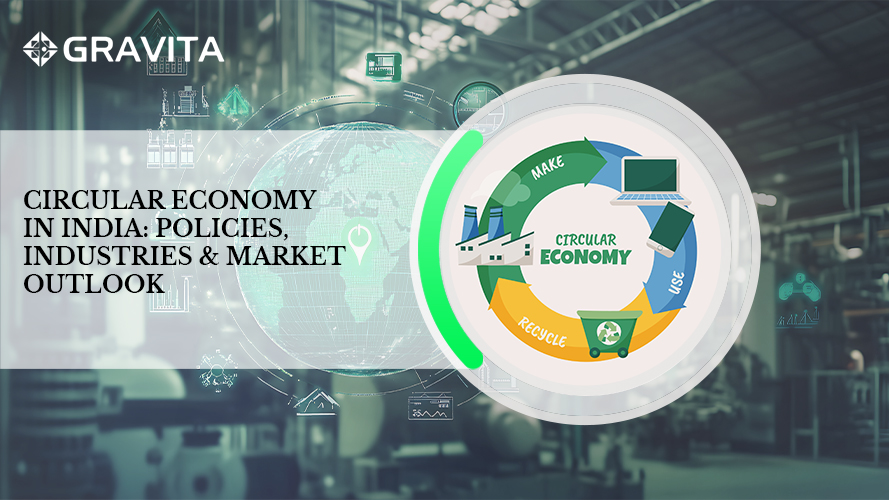
A circular economy in India focuses on three practical principles: design out waste, keep materials in use, and regenerate natural systems. Applied locally, this means design choices and business models that enable reuse, repair, remanufacture and high-value recycling at scale, together with traceability and incentives that integrate informal collectors into formal value chains. Evidence-based roadmaps from national and research bodies underline that sectoral action in plastics, batteries, e-waste and construction will deliver the largest near-term gains.
3. Policy & Regulatory Framework Driving Circular Economy in India
India’s recent regulatory architecture uses Extended Producer Responsibility (EPR) and centralized digital portals to assign lifecycle accountability and improve traceability across sectors. The Battery Waste Management Rules require producers, refurbishers and recyclers to register on the CPCB EPR portal and report fulfilment of obligations.
Plastic packaging rules have been amended to strengthen EPR targets, recycled content mandates and reporting, while national-level initiatives and NITI Aayog action plans are accelerating sectoral roadmaps for ELVs, tyres and lithium-ion battery circularity. These combined measures create both compliance drivers and market signals that make investment in formal recycling and reverse logistics commercially viable.
4. Industry Adoption of Circular Economy Practices in India
Circular economy adoption in India is accelerating across multiple industries, driven by regulation, resource constraints, and growing sustainability commitments from businesses. Some sectors have progressed faster due to clear policy frameworks and strong economic incentives.
The battery sector is one of the most advanced adopters. Lead acid battery recycling has long been established, while lithium ion battery recycling is rapidly expanding due to electric vehicle growth and Battery Waste Management Rules. Extended Producer Responsibility has formalised collection and recycling, improving traceability and compliance across the value chain.
Plastics and packaging represent another major area of circular activity. Plastic Waste Management Rules mandate EPR targets, recycled content usage, and structured reporting. This has increased demand for recycled polymers and encouraged investment in sorting, washing, and reprocessing infrastructure.
E-waste recycling is gaining momentum as electronics consumption rises. Formal recyclers are expanding capacity to handle end of life electronics, recover precious metals, and meet compliance requirements. Market projections indicate strong growth driven by urban consumption and stricter enforcement.
Metals such as lead, aluminium, and steel are inherently circular due to high recyclability. Secondary metal production reduces energy use and emissions while stabilising raw material supply for manufacturers. Construction and demolition waste recycling is also emerging, with recycled aggregates and wastewater reuse gaining policy support at the state level.
5. Market Size, Investment, and Growth Outlook
India’s circular economy market is positioned for sustained growth over the coming decade. Recycling sub-sectors such as batteries, plastics, and e-waste are witnessing increased investment as policy clarity improves and demand for secondary raw materials rises.
The e-waste recycling market is expected to grow at a strong compound annual growth rate, supported by rising electronics usage and formalisation of collection systems. Battery recycling is also expanding rapidly, driven by electric mobility, renewable energy storage, and mandatory EPR compliance.
Investors are increasingly attracted to circular economy businesses due to predictable regulatory demand, long term material recovery potential, and alignment with ESG goals. Capital is flowing into recycling plants, reverse logistics platforms, and digital traceability systems.
From a macroeconomic perspective, circular economy adoption offers significant benefits. These include reduced import dependence for critical materials, job creation across collection and processing activities, and lower environmental remediation costs. As infrastructure scales and enforcement strengthens, circular markets are expected to mature and stabilise pricing dynamics.
6. Circular Business Models Gaining Traction in India
Several circular business models are proving commercially viable in the Indian context. These models balance regulatory compliance with operational efficiency and scalability.
Producer Responsibility Organisation models help brands meet EPR obligations by aggregating collection, recycling, and reporting services. These platforms simplify compliance and allow producers to focus on core operations while ensuring regulatory adherence.
Reverse logistics and collection-as-a-service models are expanding, particularly in batteries and e-waste. These systems integrate local collectors, transporters, and recyclers into organised supply chains, improving recovery rates and transparency.
Industrial symbiosis is another emerging model, where waste or by-products from one industry become inputs for another. Manufacturers increasingly source recycled materials to reduce costs and emissions, while recyclers secure stable demand.
Digital platforms that track material flows, compliance data, and recovery outcomes are enabling scale and accountability. Together, these business models demonstrate that circular economy practices in India are moving beyond pilot projects toward commercially sustainable operations.
7. Technology and Infrastructure Needs for a Circular Economy
Technology and infrastructure form the backbone of a functional circular economy. In India, scaling circular systems requires investment in modern processing facilities, efficient logistics networks, and digital tools that enable traceability and compliance.
Advanced sorting and material recovery technologies are critical across sectors. Battery recycling requires mechanical separation systems and hydrometallurgical processes to recover metals efficiently. Plastic recycling depends on automated sorting, washing, and reprocessing lines to improve output quality and consistency. E-waste recycling relies on controlled dismantling and metal recovery systems to safely extract valuable materials.
Digital infrastructure is equally important. Centralised reporting portals, material tracking systems, and compliance dashboards improve transparency across value chains. These tools help regulators monitor compliance while enabling businesses to verify sourcing and recovery outcomes.
Physical infrastructure such as recycling parks, common treatment facilities, and authorised collection centres is still unevenly distributed across regions. Expanding this infrastructure, particularly in high consumption urban clusters, is essential to reduce logistics costs and improve formal recycling rates.
8. Key Challenges and Policy Gaps in India’s Circular Economy
Despite progress, several challenges continue to limit the pace and scale of circular economy adoption in India. One of the most significant issues is the dominance of informal waste handling. Informal operators often lack environmental controls and operate outside regulatory oversight, creating compliance and quality risks.
Another challenge is inconsistent implementation of policies across states. While national rules provide a framework, enforcement capacity and interpretation vary at the state level. This creates uncertainty for businesses operating across multiple jurisdictions.
Quality concerns around recycled materials also affect demand. Manufacturers may hesitate to adopt secondary raw materials due to inconsistent specifications or lack of certification. Strengthening quality standards and market confidence is essential to increase uptake.
Financing and technology access remain barriers, particularly for small and medium recyclers. High upfront costs for pollution control systems and compliance infrastructure can slow formalisation unless supported by incentives or shared facilities.
9. Roadmap for Businesses and Policymakers from 2026 to 2030
A coordinated roadmap is required to unlock the full potential of India’s circular economy over the next decade. For policymakers, priorities include standardising enforcement, strengthening digital reporting systems, and expanding incentives for recycled content adoption. Public procurement policies can play a major role by creating assured demand for recycled materials.
For businesses, the focus should be on designing products for recyclability, preparing for EPR compliance, and building partnerships across the value chain. Early investment in traceability, reverse logistics, and compliant recycling partners reduces long term risk.
Investors can support scale by backing modular recycling technologies, integrated collection platforms, and infrastructure that improves material recovery efficiency. Collaboration between government, industry, and finance will be essential to move from fragmented initiatives to a mature and resilient circular economy ecosystem.
10. Case Studies and Early Wins in India’s Circular Economy
Several early initiatives across India demonstrate how circular economy principles can translate into measurable environmental and economic outcomes when supported by policy and industry participation.
In battery recycling, formal Extended Producer Responsibility implementation has led to improved collection rates and higher recovery efficiency for lead and lithium based batteries. Organised recyclers working within the regulatory framework have reduced leakages into informal channels and improved traceability across the supply chain.
Plastic recycling initiatives supported by EPR targets have encouraged brands to adopt recycled content and invest in long term procurement contracts with recyclers. This has helped stabilise pricing for recycled polymers and improved quality consistency.
At the state level, circular approaches in construction and water reuse have shown success. Recycled aggregates and treated wastewater are increasingly used in infrastructure projects, reducing pressure on natural resources and lowering lifecycle costs. These early wins highlight the importance of enforcement, market linkage, and infrastructure availability in scaling circular solutions.
11. Frequently Asked Questions
What is the circular economy in India
The circular economy in India focuses on reducing waste, reusing materials, and recycling resources through policy driven frameworks such as Extended Producer Responsibility and sector specific waste management rules.
Which industries are most impacted by circular economy policies
Batteries, plastics, e-waste, metals, construction, and textiles are among the most impacted sectors due to mandatory recycling and reporting requirements.
Is circular economy compliance mandatory for businesses
Yes. Businesses in regulated sectors must comply with applicable waste management rules, EPR obligations, and reporting requirements.
How does Extended Producer Responsibility work in India
EPR places responsibility on producers to ensure collection, recycling, and proper disposal of products at end of life, supported by digital reporting systems.
What are the business benefits of adopting circular practices
Benefits include regulatory compliance, reduced raw material dependency, lower long term costs, improved ESG performance, and enhanced brand credibility.
12. Conclusion and Strategic Way Forward
India’s circular economy is transitioning from policy intent to on ground execution. Strong regulatory frameworks, growing industry adoption, and increasing investment are reshaping how materials are produced, consumed, and recovered. While challenges remain in enforcement, infrastructure, and quality standardisation, the direction of travel is clear.
For businesses, proactive engagement with circular economy principles is no longer optional. Early alignment with compliance requirements, investment in traceability, and partnerships with authorised recyclers reduce long term risk and unlock new value streams.
To build a resilient and compliant circular roadmap, organisations can read Gravita’s circular economy consultancy to understand regulatory requirements, industry best practices, and implementation strategies.
Businesses looking to strengthen compliance and recovery in regulated sectors can also explore battery recycling and EPR services to ensure responsible material management and reporting.
By combining policy alignment, operational execution, and trusted partnerships, India can accelerate its transition toward a scalable and sustainable circular economy.