


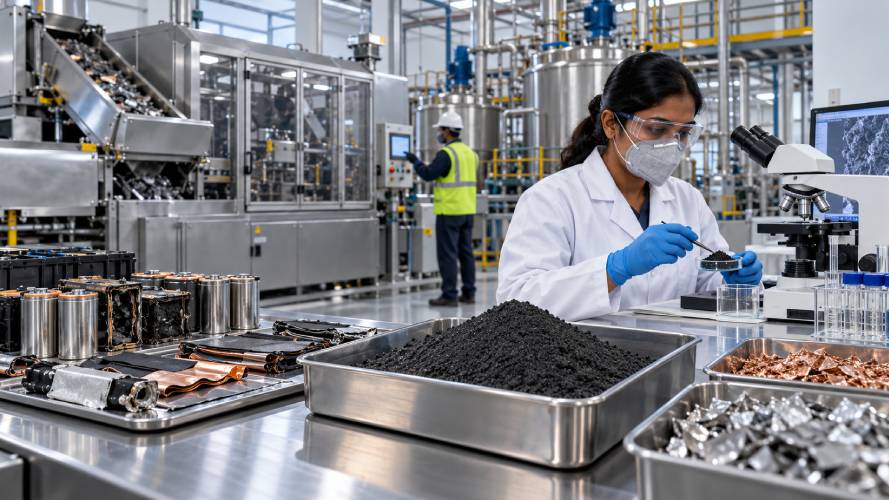
Calling black mass a single product, however, is misleading. Its composition, recovery potential and commercial value change with battery chemistry, feedstock quality and processing efficiency. Understanding these differences is essential for battery recyclers, cell manufacturers, OEMs, scrap suppliers and businesses evaluating recovered critical materials.
What Is Black Mass?
Black mass is the dark, powder-like fraction obtained during the mechanical processing of lithium-ion batteries. A typical recycling line first identifies and sorts batteries by chemistry, makes them safe for handling, removes external components and then shreds or crushes the cells. Magnetic, density-based and other physical separation systems remove steel, aluminium, copper and plastics from the shredded mixture.
The remaining fine fraction contains cathode and anode active materials. It may also retain electrolyte residues, binder, separator particles and fine pieces of current collectors. Black mass is therefore not the same as pure cathode active material, nor is it a finished battery-grade chemical. It normally requires further metallurgical processing before recovered materials can return to manufacturing.
What Is Black Mass Made Of?
There is no universal black-mass composition. The principal variables are the original cell chemistry, whether feedstock comes from manufacturing scrap or end-of-life batteries, the degree of sorting and the efficiency of mechanical separation.
Battery chemistry | Principal cathode elements | Commercial implication |
|---|---|---|
NMC | Lithium, nickel, manganese and cobalt | Value depends heavily on nickel and cobalt content, chemistry ratio and recovery terms |
NCA | Lithium, nickel, cobalt and aluminium | Often attractive for nickel and cobalt recovery, subject to purity and assay |
LCO | Lithium and cobalt | Cobalt content can support higher value when contamination is controlled |
LFP | Lithium, iron and phosphorus | Contains no nickel or cobalt; economics rely more on lithium, graphite, scale and process efficiency |
LMO | Lithium and manganese | Generally has a different value profile from nickel- and cobalt-bearing material |
Graphite from the anode can form a substantial part of black mass across several chemistries. Other constituents may include carbon additives, fluorine-bearing binder or electrolyte residues, copper, aluminium, iron and moisture. These are important because saleable value depends not only on valuable-metal content but also on the cost and difficulty of removing impurities.
Why Black Mass Composition Varies
1. Battery chemistry
An NMC battery does not yield the same black mass as an LFP or LCO battery. Even within NMC, formulations such as NMC 111, 532, 622 and 811 contain different proportions of nickel, manganese and cobalt.
2. Feedstock source
Production scrap can be more consistent because its chemistry and manufacturing origin may be known. End-of-life feedstock may combine cells from vehicles, electronics and energy-storage systems of different ages and designs.
3. Sorting accuracy
Mixed-chemistry processing produces a more complex black mass. Good identification and segregation allow the downstream refiner to select a more suitable recovery flowsheet and predict product quality more reliably.
4. Mechanical separation
Inefficient separation can leave excessive copper, aluminium, steel, casing material or plastics in the powder. These materials may reduce payable value and increase reagent consumption or purification requirements.
5. Moisture and residual electrolyte
Moisture adds non-payable weight and may affect storage, sampling and processing. Residual electrolyte and fluorine-bearing compounds also introduce safety and emissions-control considerations.
How Is the Value of Black Mass Determined?
Black mass does not have one fixed per-kilogram rate. Commercial valuation usually begins with a representative laboratory assay and the prevailing market value of recoverable materials. The final settlement may then account for expected recovery, processing charges, impurities, moisture, logistics and contractual terms.
Key value drivers include:
- Concentrations of lithium, nickel, cobalt and other payable materials
- Battery chemistry and consistency of the batch
- Graphite content and whether the processor can recover it economically
- Moisture, particle size and physical uniformity
- Copper, aluminium, iron and other impurity levels
- Presence of electrolyte, binder and fluorine-bearing compounds
- Sampling and assay methodology
- Expected metallurgical recovery and refining cost
- Batch quantity, packaging, location and transport requirements
Two visually similar batches may therefore receive very different offers. A clean, well-sorted cobalt- and nickel-bearing black mass can have a stronger payable-metal profile than mixed or highly contaminated material. LFP black mass follows a different economic model because it lacks nickel and cobalt. It should not be priced using an NMC benchmark.
From Used Battery to Black Mass
- Receipt and identification: Batteries are recorded and sorted by format, condition and chemistry.
- Discharging: Residual electrical energy is reduced using an appropriate controlled method.
- Dismantling: Packs may be opened to remove casing, battery-management systems, cables and other external components.
- Shredding or crushing: Cells and modules are mechanically reduced under controlled conditions suited to fire and electrolyte risks.
- Physical separation: Screening, magnetic separation, density separation and related systems separate iron, copper, aluminium, plastics and the fine black-mass fraction.
- Sampling and storage: The black mass is tested, packaged and stored in a covered, dry and controlled area before further refining.
This mechanical route concentrates the electrode materials but does not, by itself, produce pure lithium, nickel or cobalt products. Those outputs require additional refining.
Black Mass Recycling Routes
Hydrometallurgical processing
Hydrometallurgy uses controlled chemical treatment to transfer target metals from black mass into a liquid solution. The general route includes leaching, solid-liquid separation, purification, solvent extraction or selective precipitation, and crystallisation or drying.
After leaching, the solid residue may contain graphite and other non-leached material. The filtered solution can then be purified and processed to recover selected metals as compounds or salts, depending on the feed chemistry and the plant’s process design.
The exact sequence changes with the feed chemistry and target specification.
CPCB’s July 2026 recycling guideline states that hydrometallurgical processing is currently deployed for metal recovery from lithium-ion battery black mass in India. Facilities require controlled reagent storage, covered material handling, fume and dust controls, effluent treatment and process-specific monitoring.
Pyrometallurgical processing
Pyrometallurgy treats battery material at high temperature. It can recover selected metals into an alloy or intermediate phase and tolerate some variation in feedstock. However, lithium, aluminium, manganese and graphite may report to slag, dust or other streams unless the process includes additional recovery steps. Energy demand and gas treatment are also important design considerations.
Direct recycling
Direct recycling aims to recover and, where feasible, restore cathode active material while preserving more of its structure than conventional routes that dissolve materials into separate metal compounds. Suitability depends on chemistry, degradation, contamination and product qualification. It may reduce processing steps when the feed is clean, well-characterised and separated by chemistry. Mixed, degraded or contaminated black mass makes this route more difficult, and product qualification remains critical.
R2, R3 and R4 Recycler Categories
CPCB distinguishes non-lead-acid battery recyclers according to their activities:
- R2: Dismantling and physical separation up to black-mass generation
- R3: Processing black mass until metals are obtained in compound form
- R4: Dismantling, physical separation and black-mass refining within an integrated operation
A business that only generates black mass is therefore performing a different activity from a facility that chemically refines it into metal compounds. Approvals, infrastructure and pollution controls must match the actual activity undertaken. Gravita’s overview of the CPCB Battery Recycling Guidelines 2026 explains the broader recycler requirements.
Quality Checks Before Buying or Processing Black Mass
A transaction should be based on documented sampling and analysis rather than appearance alone. Relevant checks may include:
- Declared battery chemistry and feedstock origin
- Assay for lithium, nickel, cobalt, manganese, iron, phosphorus and graphite
- Copper, aluminium and other impurity levels
- Moisture and particle-size distribution
- Residual electrolyte and fluorine-related parameters
- Batch homogeneity and sampling method
- Packaging, labelling, traceability and storage condition
Sampling deserves special attention. A small sample taken from the top of a bag may not represent a segregated or settled batch. Contracts should define sampling, test methods, moisture correction, payable elements, deductions and dispute-resolution procedures.
Safe Handling and Regulatory Considerations
Black mass is a fine industrial material that may contain reactive residues and metal-bearing dust. It should be handled in closed or controlled systems with suitable ventilation, dust collection, PPE and spill procedures. Storage should be covered, cool, dry and protected from incompatible materials and unauthorised access.
Under India’s battery-waste framework, black-mass generation and processing should occur through appropriately registered and authorised facilities. Procurement, processing, recovered-material sales and EPR records must remain traceable. Businesses handling end-of-life cells can review Gravita’s lithium battery scrap procurement information and its detailed lithium battery recycling process.
Black Mass and the Circular Battery Supply Chain
Black mass connects end-of-life battery collection with the recovery of materials for new manufacturing. Its real value lies not in its colour or weight but in verified chemistry, low contamination, safe processing and the ability to convert its constituents into consistent products.
As battery chemistries evolve, recyclers will need flexible sorting, mechanical separation and refining systems. Gravita’s lithium battery recycling solutions cover controlled processing and material recovery for EV, electronics and energy-storage applications. Organisations evaluating lithium-battery scrap, black mass or recycling partnerships can contact Gravita India.
Frequently Asked Questions
Is black mass a finished recycled product?
No. It is generally an intermediate containing mixed cathode and anode materials. Further metallurgical processing is required to produce refined metal compounds or regenerated battery materials.
Does all black mass contain cobalt and nickel?
No. NMC, NCA and LCO streams may contain one or both, but LFP black mass contains neither nickel nor cobalt as part of its cathode chemistry.
Why does black mass pricing vary?
Pricing depends on assay, chemistry, recoverable-metal value, moisture, impurities, expected recovery, processing costs, quantity, logistics and commercial terms.
What is the main black-mass recovery route in India?
CPCB’s 2026 recycling guideline identifies hydrometallurgical processing as the route currently deployed for metal recovery from black mass in India.
Can different battery chemistries be processed together?
Mixed processing is technically possible in some facilities, but it complicates valuation, recovery and product control. Sorting by chemistry generally supports more predictable processing.
Disclaimer: This article provides general technical and regulatory information. Black-mass composition, value, recovery and compliance requirements vary by feedstock, process, facility and jurisdiction. Businesses should obtain representative laboratory analysis and verify current CPCB, SPCB/PCC, transport and contractual requirements before buying, selling or processing the material.

