


 Share
Share
CPCB Battery Recycling Guidelines 2026: Compliance Requirements for Lead-Acid and Lithium-Ion Recyclers
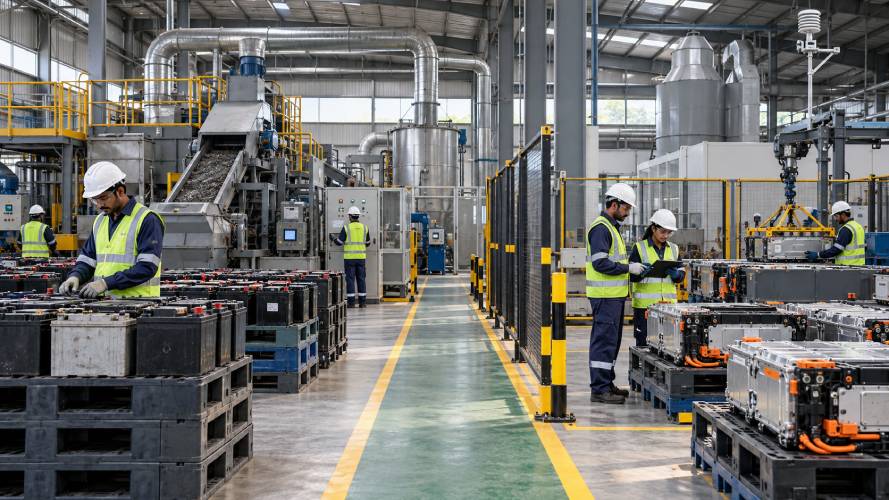
Battery recycling in India entered a more structured phase in July 2026 when the Central Pollution Control Board released detailed guidelines for recycling waste lead-acid and lithium-ion batteries. The guidelines translate the broader obligations of the Battery Waste Management Rules, 2022 into practical requirements for recycling facilities.
The guidelines address facility infrastructure, operating procedures, pollution control, worker safety, monitoring, recordkeeping and EPR-related reporting.
This guide explains the major requirements under the CPCB Battery Recycling Guidelines 2026 and what they mean for lead-acid and lithium-ion battery recyclers in India.
Why Did CPCB Issue New Battery Recycling Guidelines?
The Battery Waste Management Rules, 2022 apply to producers, dealers, consumers, collection centres, transporters, refurbishers and recyclers dealing with waste batteries. They cover portable, automotive, industrial and electric vehicle batteries, regardless of their size, chemistry or application.
While the rules establish legal responsibilities, recycling different battery chemistries requires very different infrastructure and safety measures. Lead-acid battery recycling involves corrosive electrolyte, lead-bearing dust, smelting and refining. Lithium-ion battery recycling introduces electrical, chemical and fire risks, along with the controlled processing of black mass.
The 2026 guidelines provide a more specific operating framework for these facilities. They also require recyclers to maintain procurement, recycling, recovered-material sales and EPR-related records through the CPCB online EPR portal.
Businesses that need a broader understanding of producer and recycler obligations can also review Gravita’s guide to the Battery Waste Management Rules and EPR compliance.
Who Must Follow the CPCB Battery Recycling Guidelines 2026?
The guidelines are particularly relevant to:
- Waste lead-acid battery recyclers
- Lithium-ion battery dismantling and shredding facilities
- Black mass processors and refiners
- Integrated lithium-ion battery recycling plants
- Facilities undertaking collection, handling, storage or transportation are addressed under separate CPCB guidelines issued in July 2026.
- Producers working with recyclers to meet EPR targets
- Facilities planning to expand or modernise battery recycling capacity
The technical requirements applicable to a facility depend on the battery chemistry, authorised recycling activity, installed capacity and conditions prescribed by the relevant State Pollution Control Board or Pollution Control Committee.
The Battery Recycling Value Chain Under the Guidelines
The CPCB guidelines address different stages and controls relevant to battery recycling, including handling, discharging or acid draining, storage, sorting, inspection, dismantling and recovery of metals or metal salts.
The guidelines address controls for risks such as acid leakage, fire, chemical exposure and fugitive emissions. Storage and processing arrangements should reflect the battery types and activities handled at the facility.
CPCB Requirements for Lead-Acid Battery Recycling Plants
In lead-acid battery recycling, used batteries are dismantled so that plastic components, electrolyte and lead-bearing materials can be handled separately. The recovered lead-bearing material is smelted, refined and cast into lead ingots or converted into alloys according to industrial requirements.
1. Mechanised battery breaking
Lead-acid battery recycling facilities with a capacity of more than 5,000 MTA are required to install a mechanical or automated waste battery breaking system within one year from the date of notification of the guidelines. Facilities below 5,000 MTA are given three years.
Battery cutting and breaking should take place on a concrete floor inside a covered structure. Mechanised furnace charging is also encouraged because it reduces manual handling and limits worker exposure to lead dust and fumes.
2. Covered and acid-resistant storage
Used lead-acid batteries require a separate covered storage area with impervious, acid-resistant flooring. The storage system should include an acid collection tank connected to a neutralisation system. Arrangements should also be made to control acid fumes.
Residue, slag and hazardous sludge must be kept in secured, covered areas with concrete floors. Records of their transfer to an authorised Treatment, Storage and Disposal Facility must be maintained.
3. Air pollution control systems
Rotary furnaces, refining kettles and other lead-processing equipment should be connected to appropriate air pollution control systems. Depending on the process, these may include:
- Suction hoods over charging and tapping points
- Expansion chambers and cooling ducts
- Cyclones or multi-cyclones
- Pulse-jet or mechanical-shaker bag filters
- Alkaline scrubbers
- Induced-draft fans
- Stacks with suitable monitoring access
The guidelines specify a minimum stack height of 30 metres for the listed lead-recycling systems. Stack design must also provide safe access and a monitoring platform.
4. Effluent and acid management
The CPCB guidelines specify that the unit should have an effluent treatment plant to treat wastewater from the battery-breaking system, with provision for acid neutralisation. Acidic wastewater from floor washing should be channelled to the neutralisation system.
ETP sludge must be collected, stored and disposed of as hazardous waste. Contaminated plastic battery casings should be cleaned and transferred to registered plastic processors or treated through an authorised in-house system.
5. Lead exposure monitoring
The guidelines prescribe limits for lead in the work area, stack emissions, effluent and ambient air near the facility boundary. Workers involved in lead-related activities should undergo periodic blood and urine lead testing at least once a year.
Plants must also provide appropriate gloves, masks, boots, aprons and other personal protective equipment. Effective fume extraction and housekeeping remain essential because a valid consent does not compensate for poor control of fugitive lead emissions.
CPCB Requirements for Lithium-Ion Battery Recycling Plants
Lithium-ion battery recycling requires a different compliance approach. Batteries may retain electrical charge and contain flammable electrolytes. Mechanical damage can create short circuits, chemical exposure or thermal runaway.
CPCB classifies non-lead-acid battery recyclers according to their activities:
- R2: Battery dismantling and physical separation up to black mass generation
- R3: Black mass processing until metals are obtained in compound form
- R4: Battery dismantling, physical separation and black mass processing/refining
1. Dedicated storage and fire protection
Different types of lithium-ion batteries should be stored in dedicated areas. Storage and utilisation areas require appropriate fire-protection systems, which may include hydrants, sprinklers and foam-type extinguishers.
The shredding/crushing unit should use flameproof electrical fittings and appropriate fire-protection measures. Fire-protection systems should be regularly checked and maintained.
2. Safe discharging and dismantling
Before dismantling, battery packs should be discharged to a safe level. CPCB also specifies voltage measurements during the dismantling process and temperature checks to identify anomalies.
During dismantling, external casings, battery management systems, electronics, cables and other components are separated before cells or modules enter the next processing stage.
3. Controlled shredding and separation
Shredding and crushing systems require temperature control, safe feeding arrangements and systems for collecting electrolyte or controlling its emissions. Magnetic and density separation can then recover iron, copper, aluminium and plastics while separating the black mass.
Black mass separation should take place in a covered area with suitable suction and filtration systems. Mechanised loading, unloading and transfer reduce exposure and material loss.
For a closer look at the recovery stages, see Gravita’s explanation of the lithium battery recycling process.
4. Black mass processing
Hydrometallurgical processing uses controlled leaching, filtration, purification, solvent extraction and precipitation to recover materials such as lithium, cobalt, nickel and manganese in the form of metal salts.
Processing areas may require alkaline scrubbers, bag filters and activated-carbon filtration to manage acid fumes, particulate matter, metallic salt dust and volatile organic compounds. Wastewater and treated effluent should be managed in accordance with the applicable process requirements and the conditions specified by the concerned SPCB/PCC.
Emission Monitoring and Environmental Compliance
The lithium-ion section specifies limits for source and work-zone emissions, including particulate matter, manganese, sulphuric acid mist, fluoride compounds, cobalt, copper and nickel.
Specified source and work-zone parameters must be monitored quarterly during the first year. Monitoring results should be submitted to the concerned SPCB/PCC in accordance with the applicable Consent to Operate conditions.
Recyclers should maintain monitoring results, production records and consent-related records consistently to support regulatory reporting and verification.
CPCB Registration, EPR Certificates and Quarterly Returns
Recyclers covered by the guidelines are required to register on the CPCB online EPR portal for Battery Waste Management and comply with applicable approvals and consent conditions.
Recyclers must:
- Report financial-year-wise waste battery procurement data
- Report the quantity of batteries recycled
- Report sales of recovered materials
- Generate EPR certificates through the online portal
- Transfer valid EPR certificates to producers
- Submit quarterly returns through the EPR portal
- Maintain consistency between procurement, processing, recovery and sales records
Accordingly, procurement, recycling, recovered-material sales and EPR records should be maintained consistently to support accurate reporting.
What Happens When a Recycler Violates the Guidelines?
The CPCB guidelines state that action against violations will be taken in accordance with the Guidelines for Environment Compensation under the Battery Waste Management Rules, 2022, published in September 2024.
Practical Compliance Checklist for Battery Recyclers
- Confirm that the facility's CPCB EPR registration, applicable SPCB/PCC approvals and Consent to Operate conditions cover the activities being undertaken.
- Confirm that the facility's authorised recycling activities and applicable R-category, where relevant, are correctly reflected in its approvals.
- Review battery storage, discharge, dismantling and material-transfer areas.
- Check whether automated lead-acid battery breaking applies to the plant’s capacity.
- Validate APCS, ETP, fire-protection and emergency-response systems.
- Align monitoring schedules with Consent to Operate conditions.
- Reconcile procurement, recycling, recovered-material sales and EPR data.
- Maintain hazardous-waste and TSDF transfer records.
- Train employees for the battery chemistry and chemicals they handle.
- Review compliance after every capacity, technology or process change.
Building Compliant Battery Recycling Capacity in India
The CPCB Battery Recycling Guidelines 2026 set out requirements covering facility infrastructure, battery handling, pollution control, worker safety, monitoring and EPR-related reporting.
For lead-acid recycling, the guidelines address battery breaking, acid management, lead-emission control, effluent treatment and worker exposure monitoring. For lithium-ion recycling, they address safe discharge and dismantling, fire protection, shredding, separation, black mass processing and process-specific pollution controls.
The CPCB Battery Recycling Guidelines 2026 make one principle clear: compliant battery recycling depends on a well-controlled operating system covering infrastructure, processes, safety, monitoring and traceability.
Through its Back2Recycle initiative, Gravita provides an integrated solution for the complete journey of end-of-life batteries, from collection and safe transportation to responsible recycling and recovery of valuable materials. The initiative brings together collection, compliance, safe handling and recycling under one connected ecosystem, helping ensure that batteries are directed to the right recycling pathway.
Gravita operates across lead-acid and lithium-ion battery recycling and has developed industrial recycling capabilities supported by material recovery, environmental controls and regulated procurement. Businesses evaluating a new facility can also explore Gravita’s guide to setting up a battery recycling plant in India.
For battery recycling, recovered-material supply or project-related enquiries, contact Gravita India.
Frequently Asked Questions
What are the CPCB Battery Recycling Guidelines 2026?
They are guidelines issued by the Central Pollution Control Board in July 2026 for environmentally sound recycling of waste lead-acid and lithium-ion batteries. They cover facility infrastructure, operating procedures, pollution control, safety, monitoring, recordkeeping and EPR reporting.
Do battery recyclers need CPCB registration?
Yes. Eligible recyclers must register through the CPCB EPR portal for battery waste management and comply with applicable approvals and consent conditions issued by the concerned SPCB or PCC.
What are R2, R3 and R4 lithium-ion battery recyclers?
R2 facilities undertake battery dismantling and physical separation up to black mass generation. R3 facilities process black mass until metals are obtained in compound form. R4 facilities undertake battery dismantling, physical separation and black mass processing/refining. These categories apply to battery types other than lead-acid batteries, as specified in the CPCB guideline.
Is automated breaking compulsory for lead-acid batteries?
Lead-acid battery recycling facilities with a capacity of more than 5,000 MTA are required to install mechanical or automated waste battery breaking within one year from the date of notification of the guidelines. Facilities below 5,000 MTA are given three years.
How frequently must battery recyclers file returns?
Recyclers are required to submit quarterly returns through the CPCB online EPR portal. Procurement, recycling, recovered-material sales and EPR certificate data should remain consistent across the reporting period.
Do the 2026 guidelines replace the Battery Waste Management Rules, 2022?
No. The July 2026 guidelines operate under the Battery Waste Management Rules, 2022. The CPCB document also states that they apply in addition to the January 2025 guidelines for utilisation of lithium-ion battery black mass and the January 2024 SOP for recycling lead scrap and used lead-acid batteries.
Disclaimer: This article provides a general overview for informational purposes. Regulatory requirements and consent conditions may vary by facility, process, capacity and state. Recyclers should verify current CPCB, SPCB, PCC and other applicable requirements before making compliance or investment decisions.