


 Share
Share
Aluminium Scrap Recycling in India: How Manufacturers Can Cut Raw Material Costs with Secondary Aluminium (2026)
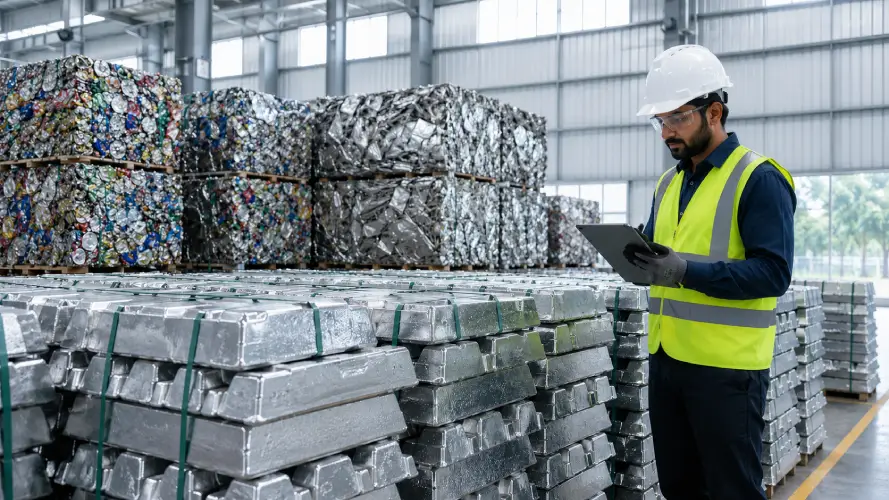
If your business consumes aluminium - for die casting, automotive components, engineering parts, electrical fittings, or construction - the gap between what you're currently paying for primary aluminium and what you could be paying for specification-grade secondary aluminium is a procurement gap worth closing.
India's aluminium recycling sector has matured significantly over the past decade. Secondary aluminium - produced by remelting and refining aluminium scrap - now accounts for a growing share of the country's total aluminium consumption, and the economics are compelling. Recycling aluminium requires up to 95% less energy than smelting primary aluminium from bauxite ore. That energy advantage flows directly into pricing: secondary aluminium alloy ingots are consistently priced below equivalent primary material, often by a meaningful margin, without compromising performance for the vast majority of industrial applications.
But not all secondary aluminium is equal. The Indian market has a wide spread of recycled aluminium suppliers - from fully integrated, ISO-certified recyclers operating multi-location facilities and supplying global customers, to informal remelters working from single furnaces without process controls or consistent scrap sourcing. The material coming off both looks like an ingot. The difference shows up in your production line.
This guide is written for procurement and production teams at Indian manufacturers who are evaluating secondary aluminium as a raw material source, or who are already buying it but want a more rigorous framework for supplier and material selection.
Why Secondary Aluminium Belongs in Your Raw Material Strategy in 2026
Several factors have converged this year to make secondary aluminium a more strategically compelling choice than it was even two or three years ago.
Primary aluminium prices have been volatile. London Metal Exchange (LME) aluminium has experienced significant price swings tied to global energy costs, Chinese production policy, and geopolitical supply disruptions. Because secondary aluminium production is largely energy-independent of the primary smelting cycle, secondary suppliers are somewhat insulated from those drivers - offering more pricing stability for buyers.
India's domestic aluminium recycling capacity is expanding. The combination of EPR (Extended Producer Responsibility) obligations on producers under the Battery Waste Management Rules and broader sustainability pressure has driven investment in formal, compliant recycling infrastructure. The scrap supply chain - drawing from automotive shredder residue, industrial manufacturing offcuts, used beverage cans (UBC), building demolition, and electrical cable waste - has deepened.
ESG and green procurement targets are now real procurement constraints. If your company reports on carbon footprint or has downstream customers asking about your Scope 3 emissions, switching a portion of your aluminium sourcing from primary to secondary is one of the fastest levers available. Every tonne of recycled aluminium you use instead of primary aluminium avoids approximately 8–19 tonnes of CO₂ equivalent, depending on the primary production route being displaced.
BIS and Quality Control Orders are tightening. The Bureau of Indian Standards has introduced Quality Control Orders covering aluminium alloys, which is raising the floor on what counts as acceptable quality in the domestic market - and pushing informal, uncertified suppliers out of the supply chain for procurement managers who are paying attention.
Understanding Secondary Aluminium: What You're Actually Buying
Secondary aluminium isn't a single material. It's a product category that spans a wide range of alloy grades, quality levels, and forms, depending on the scrap input used and the refining process applied. Getting clarity on this before you issue a purchase order is essential.
Scrap Grades and Their Impact on Output Quality
The aluminium scrap that goes into a recycler's furnace determines what can reliably come out. The main grades you'll encounter in the Indian secondary aluminium market:
UBC Scrap (Used Beverage Cans): Highly uniform 3000/5000-series alloy composition. Consistent input chemistry makes for predictable, low-contamination output. Commands a premium scrap price, but enables consistent secondary alloy production.
Taint Tabor: Clean, unpainted or lightly painted aluminium sheet scrap. Low iron, relatively clean chemistry. Suitable for a wide range of alloy outputs.
Tense / Tale: Cast aluminium scrap from automotive parts. Higher silicon content, which suits die casting alloy production. Quality varies with contamination levels.
Mixed / Zorba: Mixed non-ferrous scrap after shredding, which includes aluminium along with other metals. Requires more extensive sorting and refining. Output alloy chemistry is harder to control tightly.
A recycler sourcing predominantly UBC and Taint Tabor scrap - especially through a controlled, certified procurement network - will consistently produce better-spec alloy than one working predominantly from unsorted Zorba. Ask your prospective supplier what scrap grades constitute the majority of their input.
Common Output Alloy Grades and Their Applications
Secondary aluminium most commonly enters Indian manufacturing as foundry alloy ingots. The grades most relevant for procurement teams:
ADC12 (383): The workhorse of the die casting industry. Excellent fluidity, good pressure tightness, and strong machinability. Dominates automotive component casting - housings, brackets, crankcases, transmission cases.
LM6 (A413): High silicon content gives outstanding casting properties and corrosion resistance. Used in marine, food processing, and thin-wall casting applications.
LM2 / A380: General-purpose die casting alloy. Good mechanical strength and castability, used across engineering and electrical component manufacturing.
LM24: Offers excellent machinability alongside good mechanical strength. Widely used for automotive and general engineering castings.
ADC6 / LM5: Low-copper, higher-magnesium alloys suited for applications requiring superior corrosion resistance and anodising quality.
If your production process requires a specific alloy grade, verify upfront that your supplier manufactures to that grade with batch-level CoA (Certificate of Analysis), not just a general product range claim. View Gravita's full aluminium alloy range →
The Real Cost Calculation: Primary vs Secondary Aluminium
Procurement managers sometimes resist switching to secondary aluminium because of concerns about price variability, quality risk, or perceived complexity. It's worth working through the actual numbers.
The price differential between primary aluminium ingot and secondary die casting alloy (ADC12, for example) in India typically ranges from ₹5 to ₹15 per kg depending on market conditions. On a monthly consumption of even 100 MT, that differential represents ₹5–15 lakh in raw material cost - before you factor in the energy savings at the secondary supplier's facility (which is embedded in that lower price), and before any consideration of scrap buy-back arrangements if your own facility generates aluminium manufacturing offcuts.
The hidden cost in primary aluminium that rarely appears in a procurement comparison: primary ingot is typically an unalloyed or lightly alloyed material that requires additional alloying steps at your facility to reach casting alloy spec. Secondary alloy ingots arrive ready-to-melt in the alloy grade you need. For foundries and die casters, this eliminates an entire process step.
The hidden cost in secondary aluminium that often catches buyers out: quality inconsistency from poorly controlled recyclers. If your supplier's alloy is off-spec - too much iron, inconsistent silicon, copper contamination - you bear the cost in casting rejects, die wear, and rework. This is why secondary aluminium's cost advantage is only real if your supplier's quality systems are robust. Buying on price alone from an informal recycler almost always narrows or eliminates the cost advantage once rework and waste are counted.
What to Verify Before Buying Secondary Aluminium from Any Indian Supplier
1. Scrap Sourcing Transparency
Ask your prospective recycler where their raw material actually comes from. Do they operate their own scrap procurement network - buying directly from automotive shredders, industrial plants, cable processors, and UBC collectors - or do they buy semi-processed aluminium from third-party traders?
An integrated recycler with direct scrap procurement has full visibility into input chemistry, can reject contaminated loads before they enter the furnace, and is far less exposed to scrap availability disruptions. A recycler entirely dependent on traders is exposed to both supply volatility and the quality of decisions made upstream by parties they don't control.
See how Gravita sources and certifies aluminium scrap for manufacturing →
2. Spectro Analysis and Batch-Level CoA
For aluminium alloys, the relevant instrument is an Optical Emission Spectrometer (OES/Spectro) that can simultaneously measure the concentrations of silicon, iron, copper, manganese, magnesium, zinc, titanium, and other elements in each heat.
Ask for a Certificate of Analysis for every batch - not a generic spec sheet. The CoA should show actual measured values for each element, not just "within spec." Batch-to-batch consistency data is more useful than a single test result; consistent alloy chemistry from a supplier's facility over multiple orders tells you their process control is working.
3. Furnace and Process Setup
A recycler operating reverberatory furnaces or tilting rotary furnaces with flux treatment capability can degass the melt, remove inclusions, and control alloy chemistry precisely. One running basic pot furnaces without flux injection is doing remelting, not refining - the output alloy quality reflects that.
Ask about furnace capacity (MT per heat), flux treatment processes, degassing methods (argon or nitrogen rotary degassing is the standard), and how they manage dross. Dross yield - the non-metallic waste fraction - is an indicator of process efficiency; reputable recyclers track and minimise it.
See Gravita's manufacturing facilities across India →
4. ISO Certification and Quality Management Systems
ISO 9001:2015 (quality management) and ISO 14001:2015 (environmental management) certifications indicate the supplier has documented, audited processes - not just verbal assurances. Ask for current certificates with validity dates and the name of the certifying body.
For aluminium specifically, ISO 14001 matters because aluminium remelting generates furnace gases, dross, and wastewater that must be managed under India's environmental regulations. Certified facilities have invested in the pollution control and waste management infrastructure that uncertified operations often skip.
5. BIS Compliance and QCO Readiness
The Bureau of Indian Standards Quality Control Orders on aluminium alloys mean that alloy supplied to Indian manufacturers must conform to BIS standards. Verify that your supplier's alloys are manufactured to BIS IS specifications for the relevant grade, and that they can provide test reports demonstrating compliance. This has become a non-negotiable for any serious procurement team doing supplier audits.
6. Supply Capacity and Delivery Reliability
A supplier who quoted you a competitive price on a trial order of 10 MT may not be the same reliable partner for 80 MT a month over a 12-month contract. Ask about installed furnace capacity (MT per month), number of manufacturing locations, and their track record on on-time delivery for orders comparable to your requirement.
Multi-location manufacturers spread operational risk. A recycler with a single plant has no fallback if that plant faces a maintenance shutdown, a regulatory inspection, or a raw material shortage.
7. Green Aluminium Documentation and ESG Reporting Support
If your own company has carbon reporting obligations or downstream customers asking about recycled content in your products, your secondary aluminium supplier needs to be able to give you verified data - not just a claim. Ask whether they can provide carbon footprint documentation for their material, recycled content certificates, or any internationally recognised sustainability verification.
Read how Gravita's recycling operations support the circular economy →
Scrap Buy-Back: Turning Your Manufacturing Waste into a Cost Offset
If your facility generates aluminium scrap - gate scrap, runner and riser returns, machining swarf, or defective castings - a secondary aluminium supplier with integrated scrap procurement can buy that material directly from you. This closes a cost loop that many manufacturers leave open.
The value of buy-back arrangements depends on the scrap grade your facility generates, but for clean gate scrap and runner returns from aluminium die casting, the buy-back price is a meaningful offset against your ingot purchase cost. A supplier who handles both directions of the transaction - selling you alloy ingots and buying your scrap back - is providing a genuine raw material cycle service, not just a transactional supplier relationship.
This is also relevant for EPR purposes. As EPR frameworks continue to evolve in India, documented scrap recovery and recycling transactions through certified handlers will increasingly be relevant to industrial sustainability reporting.
Secondary Aluminium in India's EPR Framework
India's Extended Producer Responsibility regulations, currently active across batteries, plastics, tyres, and electronics, are expanding. For manufacturers consuming aluminium, the most immediately relevant dimension is whether your aluminium scrap - particularly from post-consumer sources - is being handled by a certified, compliant recycler.
If you are yourself an EPR-obligated producer (for batteries, electronics, or packaging), the secondary aluminium supplier you choose may intersect with your own compliance chain. Sourcing recycled material from CPCB-registered, certified processors creates auditable documentation of responsible sourcing - useful for your own compliance filings, ESG reports, and customer audits.
For a full breakdown of how EPR registration and certification works for producers in India, including documentation requirements and the CPCB portal process, see Gravita's guide to EPR certificates in India.
For EPR consultancy and compliance support, visit Gravita's EPR Services.
Why Gravita India for Secondary Aluminium
Gravita has been a pioneer in recycling and producing high-value materials from waste for over three decades, operating state-of-the-art manufacturing facilities across India (including Jaipur, Kathua, Mundra, and Chittoor) alongside a robust international manufacturing footprint in Asia, Africa, and Romania. Our aluminium recycling operations produce a full range of foundry alloy ingots - ADC12, LM2, LM6, LM24, ADC6, A380, and custom alloy grades - manufactured to international standards and verified through in-house OES spectro analysis.
We operate our own scrap procurement network across India and internationally, which means our input chemistry is controlled from the source, not dependent on trader supply. Our facilities are ISO 9001:2015 and ISO 14001:2015 certified, and our alloys are supplied to manufacturers across 70+ countries.
Beyond ingots, Gravita's integrated capabilities include turnkey aluminium recycling plant solutions for manufacturers looking to set up in-house recycling capacity, and EPR consultancy for producers with compliance obligations.
If you're evaluating secondary aluminium alloys for your manufacturing line - or looking to understand what your scrap buy-back options look like - our team can provide grade-specific specifications, capacity details, and pricing guidance directly.
Request a quote or product specification sheet from Gravita India →
Quick Reference: Secondary Aluminium Supplier Checklist
# | What to Verify | Document to Request |
1 | Scrap sourcing transparency | Scrap procurement process description |
2 | Batch-level CoA with OES spectro data | Certificate of Analysis per heat |
3 | Furnace and refining process capability | Process overview, furnace specs |
4 | ISO 9001 / ISO 14001 certification | Current certificates with validity dates |
5 | BIS / QCO compliance | BIS IS test reports for relevant grade |
6 | Production capacity and delivery track record | Capacity figures, delivery references |
7 | Scrap buy-back availability | Buy-back pricing and grade acceptance list |
8 | Green aluminium / ESG documentation | Recycled content certificates, carbon data |
FAQs
What is secondary aluminium and how does it differ from primary aluminium?
Secondary aluminium is produced by remelting and refining aluminium scrap - from used beverage cans, automotive parts, industrial offcuts, and other post-consumer or post-industrial sources - rather than smelting bauxite ore. It requires up to 95% less energy to produce than primary aluminium and is priced accordingly. For most foundry and die casting applications, secondary alloy ingots perform identically to primary material in the relevant alloy grade.
Which aluminium alloy grades are available from Indian secondary recyclers?
The most common grades produced by Indian secondary aluminium recyclers include ADC12 (383), LM2, LM6, LM24, A380, and ADC6. Grade availability varies by supplier. Fully integrated recyclers with controlled scrap inputs and OES spectro analysis can produce a wider range of grades to tighter tolerances than basic remelters.
How much cheaper is secondary aluminium compared to primary in India?
The price differential between primary aluminium ingot and secondary die casting alloy (such as ADC12) in India typically ranges from ₹5 to ₹15 per kg depending on prevailing LME prices, scrap availability, and alloy grade. On significant volumes, this represents a meaningful raw material cost reduction. The actual benefit to your facility depends on alloy grade consistency, which is why supplier quality systems matter.
What is the energy saving from using recycled aluminium?
Recycling aluminium uses up to 95% less energy than producing primary aluminium from bauxite ore through the Bayer and Hall-Héroult processes. This is why secondary aluminium is structurally cheaper than primary, and why it carries a significantly lower carbon footprint - typically 0.5–2 tonnes of CO₂ per tonne of secondary aluminium versus 12–17 tonnes for primary production.
Can my facility generate EPR credit from sourcing secondary aluminium in India?
EPR credit systems in India currently apply most directly to plastic, battery, tyre, and e-waste streams under their respective rules. For aluminium, the more immediately relevant EPR benefit for manufacturers is in scrap disposal - ensuring your aluminium manufacturing waste is channelled to a CPCB-compliant certified recycler, creating auditable documentation for sustainability and compliance reporting. This landscape is evolving as EPR frameworks expand.
What documents should I request from a secondary aluminium supplier before placing an order?
At minimum: Certificate of Analysis (per batch, with OES spectro data), ISO 9001 and ISO 14001 certificates, BIS IS compliance test reports for your required alloy grade, and a description of their scrap sourcing process. For larger orders, also request production capacity confirmation and on-time delivery references.