


 Share
Share
Aluminium Recycling in India 2026: Step-by-Step Process, Types of Scrap & Current Price Guide
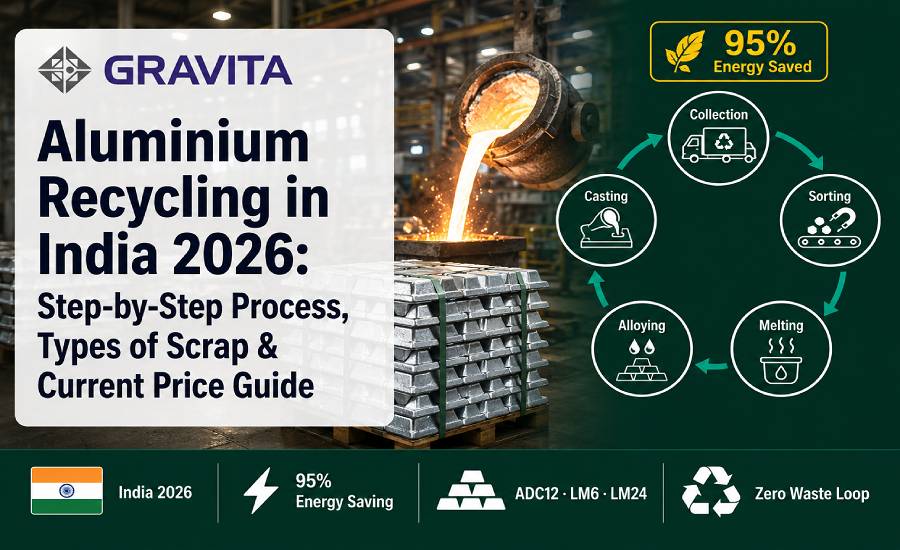
India is in the middle of an aluminium revolution. With one of the fastest-growing automotive, construction, and packaging sectors in the world, the country's demand for aluminium is expected to nearly double over the next decade. Yet meeting that demand purely through primary production - bauxite mining, alumina refining, and electrolytic smelting - is energy-intensive and resource-intensive at large scale.
Secondary aluminium, produced by recycling aluminium scrap, is the answer. Recycling uses just 5% of the energy required to produce primary aluminium. The quality of recycled aluminium alloys, when properly processed, can achieve specifications comparable to primary metal for many industrial applications. And India, with its enormous and growing domestic scrap generation, is well-positioned to build a world-class secondary aluminium industry.
This guide covers how aluminium recycling actually works in India - the step-by-step process, the types of scrap used, and current market price trends - so that manufacturers, scrap traders, procurement managers, and recyclers have a complete picture.
India's Aluminium Recycling Landscape in 2026
India is among the world’s major aluminium-producing and consuming markets. The secondary (recycled) segment now accounts for an estimated 35–40% of total aluminium supply in India, and this share is growing steadily as scrap availability increases with the maturation of India's aluminium-consuming industries.
The secondary aluminium industry is centred in clusters across the country:
Rajasthan - Jaipur and surrounding areas; significant secondary smelting and alloy production
Gujarat - Ahmedabad, Rajkot, and Surat; major die casting and aluminium alloy manufacturing hubs
Maharashtra - Pune and Mumbai; strong automotive and engineering demand driving secondary alloy consumption
Tamil Nadu - Chennai and Coimbatore; automotive components and die casting industry
Uttar Pradesh - Agra, Kanpur, and Moradabad; diversified aluminium product manufacturing
India's secondary aluminium producers serve a wide range of downstream industries: automotive die casting, architectural extrusion, packaging foil rolling, construction, consumer durables, and electrical wire and cable manufacturing.
Why Aluminium Recycling Is More Important Than Ever in India
Three converging trends are making aluminium recycling increasingly central to India's industrial economy in 2026:
1. Automotive Lightweighting
India's automotive industry is shifting toward lighter vehicles to meet fuel efficiency and emission norms under BS-VI Phase 2 and the emerging CAFE (Corporate Average Fuel Efficiency) standards. Aluminium die castings for engine components, gearboxes, wheels, and structural body parts are replacing cast iron and steel. This is dramatically increasing the consumption of secondary aluminium alloys - particularly ADC12 and similar die casting grades - and generating a growing stream of automotive aluminium scrap for recycling.
2. EV Manufacturing and Battery Enclosures
India's electric vehicle push under the FAME II and PM E-DRIVE programmes is creating new demand for aluminium in battery enclosures, motor housings, and structural components. As these vehicles reach end-of-life in the coming years, they will generate a new, high-value stream of aluminium scrap that will feed back into the secondary industry.
3. Packaging and Circular Economy Targets
India's evolving EPR (Extended Producer Responsibility) framework for packaging materials is encouraging the organised collection of aluminium packaging - including beverage cans (UBC scrap) and aluminium foil - from the waste stream. UBC scrap is considered a high-value and highly recyclable scrap category because of its relatively consistent alloy composition. Understanding how UBC scrap is priced and recycled in India is increasingly important for beverage companies, packaging manufacturers, and recyclers.
Step-by-Step: How Aluminium Recycling Works in India
The recycling of aluminium from scrap to finished alloy ingot is a technically sophisticated multi-stage process. Here is how it works at an industrial secondary aluminium facility:
Stage 1 - Collection and Incoming Material Inspection
Aluminium scrap is sourced from multiple channels: direct purchase from industrial generators (automotive stamping plants, extrusion manufacturers, die casters), through organised scrap dealers and traders, from municipal collection programmes (particularly for UBC and domestic scrap), and through imports of pre-consumer process scrap.
At the recycling facility, incoming scrap is weighed and visually inspected. A representative sample is taken for preliminary chemical analysis using a portable X-ray fluorescence (XRF) analyser to establish the approximate alloy composition before the lot is priced and accepted.
Stage 2 - Sorting and Segregation by Scrap Grade
Aluminium scrap is not homogeneous. Different alloy families - 1000 series (pure aluminium), 3000 series (aluminium-manganese), 5000 series (aluminium-magnesium), 6000 series (aluminium-magnesium-silicon), and the high-silicon die casting alloys - have different compositions that affect the value and appropriate end use of the recycled material.
Manual sorting by experienced operators is supplemented by sensor-based sorting systems (XRF sorting conveyors, eddy current separators) at larger facilities. Proper segregation at this stage directly determines the quality and yield of the final recycled alloy.
Stage 3 - Preparation, Shredding, and Size Reduction
Bulky scrap - vehicle parts, extrusion offcuts, engineering components - is shredded or cut to manageable sizes (typically under 150 mm) to improve handling and increase surface area for efficient melting. Thin gauge material (foil, beverage cans) may be baled and densified to reduce oxidation losses during melting.
At this stage, non-aluminium contaminants - steel inserts, plastic coatings, rubber, and iron fasteners - are removed as far as practicable. Organic coatings may be removed by thermal pre-treatment (decoating or delacquering) in a controlled atmosphere, recovering the coating energy and reducing dross formation in the melt furnace.
Stage 4 - Melting in Rotary or Reverberatory Furnace
Prepared scrap is charged into the melting furnace. Secondary aluminium recyclers in India use one of two primary furnace types:
Reverberatory furnaces (open-hearth type) - widely used for cleaner, pre-sorted scrap grades. Energy efficient for large volumes of relatively uncontaminated scrap.
Tilting rotary furnaces (TRF) - preferred for mixed, contaminated, or painted scrap. Salt flux is added with the charge to capture oxides and non-metallic impurities in a molten slag layer, achieving high metal recovery rates from difficult scrap streams.
Melting temperatures range from approximately 700°C to 800°C. Fluxes (chloride-based salt fluxes or proprietary flux compounds) are added to suppress oxidation, float oxides and non-metallic material to the surface as dross, and facilitate separation of the melt from contaminants.
Stage 5 - Dross Removal and Initial Melt Analysis
Molten dross that forms on the surface of the melt is raked off and set aside for further processing. Dross from aluminium melting still contains 30–70% metallic aluminium (recoverable by rotary salt furnace processing or mechanical pressing), so it is not waste - it is a by-product managed within the plant's circular material loop.
A sample of the molten metal is taken and analysed on the plant's spectrometer (Optical Emission Spectrometer, or OES) to determine the exact alloy composition in real time.
Stage 6 - Spectrometric Analysis and Alloy Correction
The OES analysis results are compared against the target alloy specification - for example, ADC12 (aluminium die casting alloy), LM6, LM24, or a customer-defined specification. Based on the analysis, the metallurgist adds:
Primary aluminium (ingot or wire) to dilute excess alloying elements
Master alloys (Al-Si, Al-Cu, Al-Mg, Al-Mn) to bring specific elements up to specification
Alloying elements (silicon, copper, magnesium, manganese, zinc) as pure metal additions for precise composition adjustment
This spectrometric alloy correction process is what distinguishes a high-quality secondary alloy producer from a commodity remelter. It ensures the recycled alloy meets international and customer specifications consistently across every heat. Gravita India's aluminium operations follow this rigorous alloying discipline, as described in detail in our guide to aluminium alloy ingot manufacturing.
Stage 7 - Degassing and Refining
Dissolved hydrogen gas in the aluminium melt is a major cause of porosity in die castings and other downstream products. After composition adjustment, the melt is treated with a rotary degassing unit - an impeller rotating in the melt while inert gas (nitrogen or argon) is injected. The bubbles of inert gas rise through the melt, capturing dissolved hydrogen and removing it from the bath.
Additional refining to remove non-metallic inclusions may be performed using ceramic foam filters during transfer of the melt to the holding furnace or casting station.
Stage 8 - Casting into Ingots, Billets, or Sows
The refined, composition-corrected melt is cast into the final product form:
T-bar and sow ingots (typically 5–22 kg) - the most common product form for die casting and foundry customers
Rolling ingots / slab - for customers who will hot-roll the aluminium into sheet
Extrusion billets - cylindrical forms for extrusion press customers
Wire rod - for electrical wire and cable applications
Finished ingots are stamped with heat number, alloy grade, and weight, and packaged in bundled stacks on wooden pallets for delivery.
Stage 9 - Final Inspection and Dispatch
Each heat of finished ingots is subjected to final quality checks: chemical analysis confirmation from cast samples, visual inspection for surface defects, and dimensional/weight verification. A Material Test Certificate (MTC) is issued with each shipment, documenting the alloy grade, chemical composition results, heat number, and the producing facility's quality accreditation details.
Types of Aluminium Scrap in India
India's aluminium scrap supply comes from a diverse range of industrial and post-consumer sources. Understanding the different scrap grades is essential for both sellers and buyers:
Scrap Grade | Description | Alloy Series | Key Industries |
UBC (Used Beverage Cans) | Post-consumer aluminium beverage cans - consistent 3000/5000 series alloys | 3xxx / 5xxx | Packaging, beverage manufacturing |
Extrusion Scrap (6063 / 6061) | Offcuts, rejected sections, and end-of-life extrusions from windows, doors, structures | 6xxx | Construction, fenestration, transport |
Die Casting Scrap (ADC12, LM24) | Returns, runners, gates, and scrapped castings from die casting operations | High-Si (Al-Si-Cu) | Automotive, engineering, consumer goods |
Automotive Zorba | Mixed aluminium from shredded end-of-life vehicles - requires sorting | Mixed | Automotive dismantling, shredding industry |
Aluminium Wire and Cable Scrap | End-of-life electrical conductors; may require stripping or shredding | 1xxx / EC grade | Power sector, construction, demolition |
Domestic / Commercial Utensil Scrap | Post-consumer cookware, household items; often mixed alloy | Mixed | Household waste, recycling aggregators |
Turnings and Borings | Machining swarf from CNC and precision machining operations; high oil contamination | Various | Precision engineering, automotive machining |
Aluminium Foil Scrap | Production offcuts and post-consumer packaging foil | 1xxx / 8xxx | Packaging, food processing |
Construction Scrap | Roofing sheet, cladding, and structural aluminium from demolition | 1xxx / 3xxx / 5xxx | Construction, demolition, infrastructure |
Key Aluminium Alloy Grades Produced from Recycled Scrap
India's secondary aluminium industry produces a wide range of alloy grades to serve different downstream applications. The most important commercial grades in India include:
Alloy Grade | Standard | Key Composition | Primary Application |
ADC12 | JIS H5302 | Al-Si (9.6–12%), Cu (1.5–3.5%) | Automotive die castings - engines, gearboxes, wheels |
LM6 | BS 1490 | Al-Si (10–13%) | Marine castings, food industry equipment, thin sections |
LM24 | BS 1490 | Al-Si (7.5–9.5%), Cu (3–4%) | Die castings - automotive and general engineering |
Al 85% (Secondary Ingot) | Customer spec | Al ≥ 85% | Deoxidation in steel making, general foundry use |
6063 Billet | AA 6063 | Al-Mg (0.45–0.9%), Si (0.2–0.6%) | Architectural and structural extrusions |
Gravita India's aluminium manufacturing facilities produce ADC12, LM6, LM24, and Al-85% secondary alloy ingots. For a detailed breakdown of ingot grades, properties, and applications, our guide to aluminium alloy ingots provides complete technical information.
Energy and Environmental Benefits of Aluminium Recycling
The case for aluminium recycling in India goes beyond economics. The environmental advantages are substantial and well-documented:
Aluminium recycling can reduce energy consumption by up to 95% compared to primary aluminium production
Industry studies commonly estimate carbon reductions of over 80–90% depending on process conditions.
No bauxite mining - recycling eliminates the need for bauxite extraction and red mud generation, which are significant environmental liabilities of primary aluminium production
Infinite recyclability - Aluminium can be recycled repeatedly without significant loss of core material properties.
For a detailed analysis of the economic and environmental benefits, including data on energy savings, job creation, and India's sustainability goals, see our dedicated guide on the economic and environmental benefits of aluminium recycling.
Green aluminium - secondary aluminium produced with high recycled content and renewable energy - is becoming a commercial differentiator for Indian manufacturers serving export markets with carbon disclosure requirements. Our guide to green aluminium and sustainable metal production covers what this means for Indian industry.
How to Sell Aluminium Scrap in India - A Practical Guide
If you are an industrial generator of aluminium scrap - a die casting plant, automotive manufacturer, fabricator, or construction company - here is how to maximise the value from your aluminium waste stream:
Step 1 - Segregate Your Scrap at Source
Mixed aluminium scrap is always worth less than segregated, identified scrap. Wherever possible, keep 6063 extrusion scrap, ADC12 die casting returns, and wire scrap in separate bins. The price premium for clean, segregated scrap more than covers the cost of sorting.
Step 2 - Know Your Alloy
If you know the alloy designation of your scrap (from your production records or the original material certificate), communicate this to the scrap buyer. Identified alloy scrap commands a significant premium over unidentified mixed scrap because it reduces the recycler's spectrometric analysis and alloy correction costs.
Step 3 - Minimise Contamination
Iron inserts, steel fasteners, and non-aluminium metals contaminate the scrap and reduce its value significantly. Remove steel bolts, inserts, and mixed metal components before selling. Similarly, oil-contaminated turnings are worth less than clean turnings - dewatering or centrifuging cutting fluid from swarf adds value.
Step 4 - Get Multiple Quotes and Verify Credentials
Contact at least 2–3 authorised recyclers and scrap buyers. Verify that any buyer you work with holds appropriate environmental and CPCB authorisations - unregistered scrap dealers may offer slightly higher prices but expose your company to compliance risk under EPR and Hazardous Waste Management Rules. Understanding what to look for in a trusted and compliant scrap buyer is important for any industrial generator.
Step 5 - Understand the Pricing Basis
Reputable aluminium recyclers price scrap based on the LME aluminium price for a specified averaging period (e.g., LME 3-month average for the delivery month), adjusted for scrap grade, yield, and freight. Ask your buyer to explain the pricing formula - transparency in pricing is a mark of a professional recycler.
Aluminium Recycling and the Benefits for Modern Indian Manufacturing
The growing availability of quality secondary aluminium alloys in India is giving manufacturers a competitive advantage that is increasingly important as sustainability requirements tighten. Automotive OEMs sourcing aluminium die castings, construction companies using aluminium profiles, and consumer electronics manufacturers are all beginning to specify recycled content in their supplier qualification requirements.
For a deeper look at how aluminium alloys - secondary and primary - are transforming manufacturing in India, see our analysis of the benefits of aluminium alloys in modern manufacturing.
Frequently Asked Questions (FAQ)
What is the current aluminium scrap price in India in 2026?
Aluminium scrap prices vary based on alloy grade, contamination levels, LME trends, freigh and market demand.
What is secondary aluminium?
Secondary aluminium is aluminium produced by melting and refining aluminium scrap, rather than through primary production from bauxite ore. When properly processed, secondary aluminium alloys meet the same industrial specifications as primary alloys. Secondary aluminium uses approximately 95% less energy to produce than primary aluminium, making it highly attractive economically and environmentally.
How is aluminium scrap graded in India?
Aluminium scrap is graded by alloy family (identified vs mixed), form (sheet, extrusion, casting, wire), contamination level (clean vs painted, coated, or mixed), and iron/non-aluminium content. ISRI (Institute of Scrap Recycling Industries) codes such as Taint/Tabor, Twitch, Talk, and Zorba are internationally recognised grade descriptors, though Indian trading terminology often uses local grade names based on source or form.
Can all aluminium alloys be recycled together?
Not efficiently. Different aluminium alloy families have significantly different compositions - mixing high-silicon die casting alloys (Al-Si) with wrought extrusion alloys (Al-Mg-Si) produces a material that may not meet the specifications of either. Segregated, identified scrap is always more valuable and produces better quality recycled alloy. However, mixed scrap can be processed into lower-grade deoxidation aluminium or back-alloy products with appropriate metallurgical management.
How much energy does aluminium recycling save vs primary production?
Aluminium recycling saves approximately 95% of the energy required for primary production. Producing 1 tonne of secondary aluminium requires approximately 700 kWh of electrical energy, while producing 1 tonne of primary aluminium from bauxite requires 14,000–17,000 kWh. This massive energy saving directly reduces production costs and carbon emissions.
What is ADC12 aluminium alloy and where does it come from?
ADC12 is a Japanese Standard (JIS H5302) aluminium die casting alloy with approximately 9.6–12% silicon and 1.5–3.5% copper. It is the most widely used die casting alloy in India's automotive sector. ADC12 ingots are primarily produced by secondary aluminium smelters from automotive die casting scrap, which has a naturally matching composition. Gravita India produces ADC12 ingots from recycled automotive scrap at its Rajasthan facility.
What is the difference between aluminium scrap and aluminium dross?
Aluminium scrap refers to metal-rich material suitable for direct remelting - sheets, extrusions, castings, wire, and similar forms. Aluminium dross is the by-product that forms on the surface of the molten aluminium melt during smelting - a mixture of aluminium oxide, salt flux (in salt furnace processes), and entrained metallic aluminium. Dross is a secondary material, not scrap; it requires separate processing (rotary salt furnace or mechanical pressing) to recover the entrained metallic aluminium.
Conclusion
Aluminium recycling in India is not just an environmental good - it is an economic imperative for a country that needs to supply its rapidly growing industries with affordable, quality aluminium while reducing energy consumption and carbon emissions. The step-by-step process, from collection and sorting through spectrometric alloying and precision casting, is a genuinely sophisticated industrial activity that delivers high-quality secondary alloys meeting the needs of automotive, construction, packaging, and electrical industries.
For scrap generators, understanding the types of scrap and how pricing is determined helps maximise the value of your material. For manufacturers, understanding the rigour of the recycling process provides confidence in secondary alloy quality. And for India's industrial sector as a whole, the growth of a strong secondary aluminium industry is a critical part of building a more sustainable, circular economy.
Aluminium recycling operations should be carried out in compliance with applicable environmental, occupational health, and waste management regulations. Proper handling of dross, salt slag, emissions, and contaminated scrap is essential for responsible recycling operations.
About Gravita India's Aluminium Division
Gravita India is an integrated aluminium recycler and secondary aluminium alloy manufacturers. Gravita's aluminium operations - based in Rajasthan with trading operations across India - process a diverse range of aluminium scrap streams into high-quality alloy ingots including ADC12, LM6, LM24, Al-85%, and customer-specific alloy grades. The process involves rigorous spectrometric analysis, alloy correction, rotary degassing, and quality-certified casting for demanding automotive and industrial customers.
Looking to sell aluminium scrap, source secondary alloy ingots, or explore recycling partnership opportunities? Contact Gravita India today for current pricing and supply information.